NVIDIA’s AI Boom Faces a New Test as Huang Resigns and Customer Spending Risks Mount
November 12, 2026

Asian markets sold off as investors waited for Nvidia’s quarterly results and questioned whether the AI rally can hold: South Korea’s Kospi fell 1.76% to 5,197.46, Japan’s Nikkei 225 dropped 2.42%, and China’s Shanghai Composite and Shenzhen Component lost 0.87% and 1.57%, while Hong Kong’s Hang Seng edged up 0.49%.
In Taiwan, the three major institutional investor groups recorded combined net sales of NT$114.055 billion, including NT$70.189 billion from foreign investors; domestic investment trusts ended a 24-session buying streak with NT$17.962 billion in net sales.
Central Bank Governor Yang Chin-long attributed the volatility to concerns about AI financing, uncertainty over U.S. midterm election results and news about Jensen Huang, calling the selloff “short-term turbulence” and saying the National Stabilization Fund may have limited its scale.
Nvidia’s earnings, scheduled after Tuesday’s close, and Anthropic’s expected stock-market debut emerged as major tests of appetite for AI stocks; analysts expected Nvidia to post 90% profit growth on $109 billion in third-quarter revenue.
Expectations for Nvidia had risen since the previous quarter on anticipated strength in Blackwell chips, while Morningstar analysts forecast another earnings beat and a raised outlook, pointing to strong spending by cloud providers and enterprises.
Anthropic was expected to seek an approximately $1.3 trillion valuation in an IPO during the week; a regulatory filing described an offering of 825 million shares at $70 to $78 each, potentially raising more than $61 billion at the midpoint.
Behind the market nerves is a basic financing question: how data-center operators will fund enormous AI infrastructure bills before they generate profits; CoreWeave moved to raise $4 billion in investment-grade bonds, and Nvidia-backed neocloud company Nebius cited further funding needs ahead of its IPO.
The spending cycle also depends on hyperscalers seeing adequate returns: if they cut capital expenditures, demand for Nvidia’s products could weaken directly.
Nvidia’s largest customers are potential competitors, too, as cloud providers develop specialized chips or shift workloads to control costs, although Nvidia’s integrated platform and software ecosystem make its systems difficult to replace.
The cash-flow picture varies across customers: Microsoft’s Azure revenue grew 48% in the September quarter, and Microsoft generated $18.6 billion in free cash flow despite spending $45.2 billion on capital expenditures.
Other risks include margin pressure from AI infrastructure costs, rising inventory and weaker free cash flow, potential PC and gaming demand weakness, and valuation sensitivity to spending delays or analyst target cuts.
Nvidia’s July 26 filing also showed financial exposure to the infrastructure buildout, including $36 billion in agreements to buy AI cloud capacity left unsold to others, $20 billion in data-center leases it expects to reassign, and $3.5 billion in guarantees on cloud partners’ lease obligations.
Summary based on 36 sources
Get a daily email with more Tech stories
Sources

24/7 Wall St. • Nov 12, 2026
Michael Burry Says Nvidia Has Bigger Problems Than Jensen Huang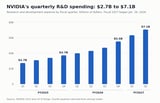
Research & Development World • Nov 13, 2026
NVIDIA’s R&D spending more than doubled in two years. Its customers’ borrowing will help decide what happens next.
Razón y Saber • Nov 12, 2026
Nvidia Built the Machines Behind AI and Now Faces Its Biggest Test