KT and Samsung's AI-Powered Network Trial Promises Smarter Stadium Connectivity
November 2, 2026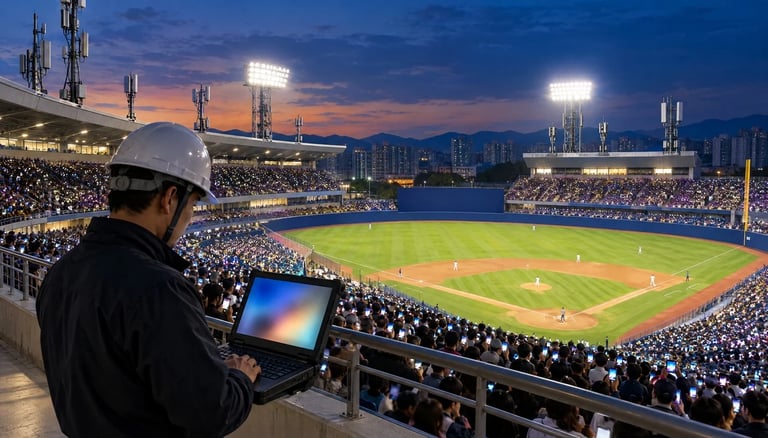

KT and Samsung conducted a three-month autonomous wireless network trial at KT Wiz Park in Suwon from July to around October 2026, using AI Cell Twin to test proactive network optimization in a live stadium environment.
Lee Jong-sik, head of KT’s Future Network Lab, said the project demonstrates AI Cell Twin’s ability to support autonomous operation in commercial networks and to build networks that actively respond to changing conditions.
The test used live game traffic to measure improvements and validate AI-driven base-station adjustments before applying them to the 5G network.
Market impact is described as directional, with potential cost and capacity benefits for operators if software-based tuning reduces the need for manual optimization.
The report notes these are best-case field-test figures, not averages, and excludes user-experience metrics or a commercial deployment.
The stadium’s variable crowds and high data demand during games provided a proving ground for adapting base stations to rapid changes in user behavior.
The demonstration environment was chosen for its variable traffic and spikes around games to test responsiveness to rapid user movements and data demand.
Unlike rule-based automation, AI Cell Twin considers user distribution, network status, and perceived quality, predicting outcomes in a virtual space before deployment.
Future plans include more fall testing, clearer baselines, non-stadium pilots, incorporation of user-experience metrics, and exploring potential rival twins from competitors.
The work touches on latency and jitter for gaming and cloud gaming, framing the stadium test as a step toward more autonomous network management rather than just faster speeds.
The system tests optimal base-station operation plans in a real wireless network via a virtual space before applying them live.
AI generates candidate settings for antenna direction and width, which are validated by the digital twin and then applied to the live network based on performance predictions.
Summary based on 9 sources
Get a daily email with more Tech stories
Sources


Shattered • Nov 2, 2026
KT, Samsung AI Cell Twin Cuts Traffic Gap 34% [2026]
The Asia Business Daily • Nov 2, 2026
KT, Samsung Electronics Validate AI Technology for Distributing Traffic at Baseball Stadium - The Asia Business Daily