PJM Monitor: Data Centers Added $5.73 Billion to Capacity Auction Revenue
November 8, 2026

AI infrastructure is creating visible cost pressures in electronics and electricity systems, while evidence of broad productivity gains remains unsettled.
That tension is reflected in PJM’s July capacity auction, which set payments for the 2028/2029 delivery year and generated about $16.41 billion in revenue.
PJM, which serves all or parts of 13 states and Washington, D.C., uses advance auctions to pay power resources to remain available; the auction ran from June 30 to July 7, 2026.
PJM’s independent market monitor reran the auction without the forecast 16,436 megawatts of new and expanded data-center load, holding other assumptions constant, and estimated revenue would have been about $10.68 billion—a modeled difference of roughly $5.73 billion, or 34.9% of actual revenue.
That $5.73 billion is an estimate of the auction’s capacity-market effect under its assumptions, not a direct calculation of household bill increases or AI’s impact alone; actual customer effects depend on contracts and local regulation.
The monitor said data-center growth was the primary reason for recent and expected capacity-market conditions, including high prices and a shortfall in cleared capacity, and estimated there would have been no shortfall without forecast data-center demand.
Across the last four capacity auctions, the report estimated data-center load added about $29.37 billion in costs, but did not calculate a per-household bill impact or identify how much of the load came specifically from AI.
A separate scenario that removed all data-center load, including existing demand, estimated a $6.27 billion impact; the monitor cautioned that scenario results cannot simply be added together.
Demand forecasts carry risks in both directions: underestimating data-center needs can contribute to shortages, while building for projects that use less power than expected can leave costs spread across fewer customers.
To limit the burden on other customers, the monitor recommended requiring new data-center load to bring its own generation, while noting that existing data-center demand would remain an issue unless addressed separately.
Virginia has created a separate rate class for large Dominion Energy Virginia customers, with safeguards intended to make them cover more of the costs of serving them; new large-load customers contracting from January 1, 2027, must commit to take and pay for electricity for at least 14 years.
The next PJM auction, for the 2029/2030 delivery year, was scheduled for December 9–15, 2026, and the monitor expected an additional impact of approximately the same size as across the previous four auctions.
Summary based on 3 sources
Get a daily email with more Tech stories
Sources

CryptoSlate • Nov 8, 2026
A single AI forecast inflates US power auctions by $5.7B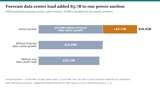
FourWeekMBA • Nov 8, 2026
Data Center Forecast Added $5.7B to a $16.4B Power Auction
CryptoNews • Nov 8, 2026
A single AI forecast inflates US power auctions by $5.7B