Brief mRNA Treatment Helps Damaged Mouse Hearts Regenerate Muscle and Pump Better
November 9, 2026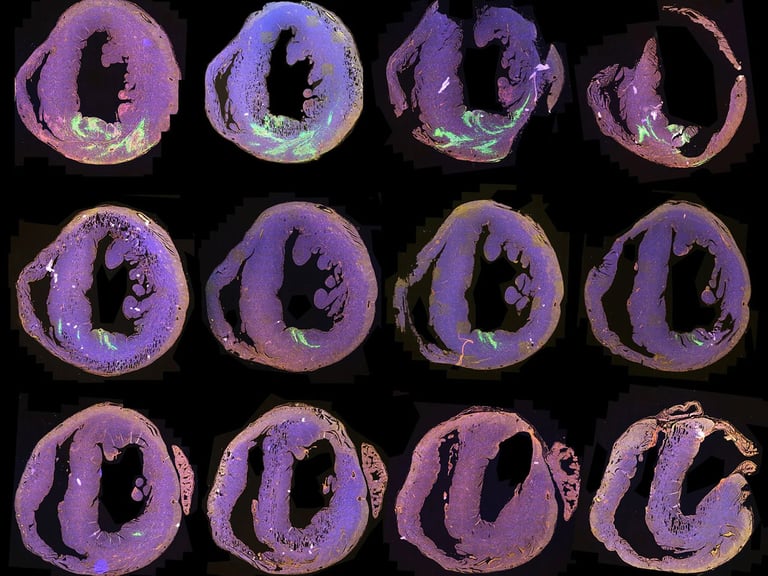

Adult hearts have little ability to replace muscle cells lost after a heart attack, and current treatments can ease symptoms and slow heart failure but cannot restore that lost muscle.
University of Cambridge researchers report that a short-lived modified-mRNA treatment encoding Myc and cyclin T1 stimulated heart-muscle cell division and improved cardiac function in mice after experimentally induced heart attacks.
Injected directly into the heart, the treatment gives cells temporary genetic instructions to make Myc and cyclin T1, proteins that help regulate cell division.
A single dose produced a brief protein pulse detectable at one and four hours but gone by 24 hours, limiting the duration of the growth signal.
The team found that Myc alone was not enough to drive adult heart-muscle cells to divide, linking the shortfall to low levels of P-TEFb, a protein complex that includes CDK9 and cyclin T1.
Cell-cycle activity was greatest near the injury: 25.1% of cardiomyocytes in the infarct border zone were Ki67-positive and 6.9% were positive for phospho-histone H3, compared with 6.2% and 2.9% in undamaged areas.
The treatment increased cardiomyocyte DNA synthesis, mitosis and left-ventricular muscle area without increasing cell death; however, scar size did not differ significantly, and the survival difference was not statistically significant.
Because the treatment did not reduce acute cell death, researchers attributed the improved heart function to renewed muscle formation rather than immediate protection of heart tissue.
In laboratory tests, the modified RNA did not transform cells, and no tumors were observed in treated animals during monitoring; the investigators said the Myc signal was short-lived partly because of normal protein degradation.
The researchers said tightly limiting Myc activation to 48 hours and restricting it to the heart avoided the lethality seen with less controlled stimulation, underscoring the importance of timing and location.
The findings are still preclinical: the study used open-chest injections and a commercial transfection reagent unsuitable for clinical use, so further work must develop appropriate delivery and minimally invasive administration and test dosing, arrhythmia risk and lasting benefit in larger animals.
Published in Nature Cardiovascular Research, the study received British Heart Foundation funding for further work.
Summary based on 11 sources
Get a daily email with more Science stories
Sources
University of Cambridge • Nov 9, 2026
Experimental treatment promotes repair after heart attack damage in animal study
News-Medical • Nov 9, 2026
New mRNA therapy reawakens heart muscle cells to repair damage
Medical Xpress • Nov 9, 2026
Experimental mRNA therapy promotes repair after heart attack damage
BIOENGINEER.ORG • Nov 9, 2026
Experimental mRNA Therapy Promotes Heart Repair in Mice Following Heart