Ariane 64 Gears Up for Maiden Flight, Aims to Deploy 32 Amazon Satellites
February 10, 2026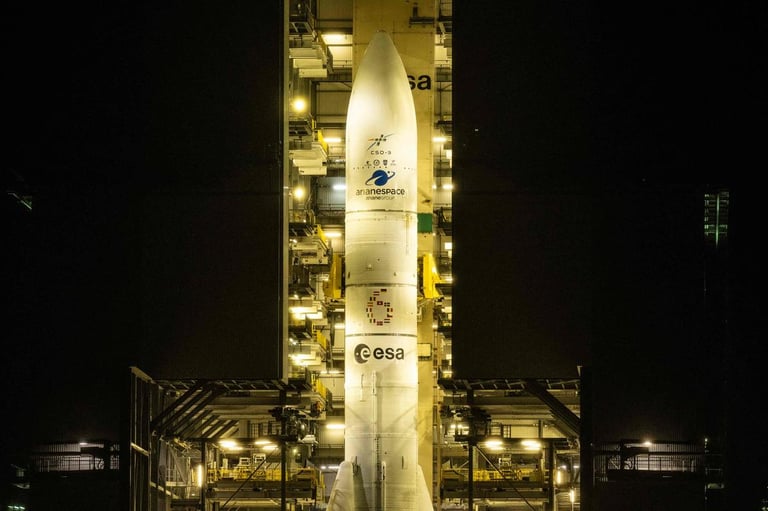


Europe’s most powerful Ariane 6 variant, the Ariane 64, is set for its maiden flight from Kourou with the goal of deploying 32 Amazon Leo satellites for their broadband constellation.
The four-boosters configuration doubles payload capacity, delivering roughly 21.6 tonnes to low Earth orbit versus about 10.3 tonnes with two boosters, marking a major performance jump.
The mission duration is about one hour and 50 minutes, with satellites deployed in pairs after reaching near-Earth orbit as Europe pursues independent access and stronger competition with SpaceX.
Engine testing occurs on-site under near-real launch conditions, followed by a two-to-three week cycle before final integration, reflecting stringent security and team investment.
ArianeGroup coordinates cross-European manufacturing and testing across Vernon and Les Mureaux, assembling components under strict security before shipment to French Guiana.
Final assembly and testing see European components travel to South America under confidential processes to ensure readiness for launch.
Key leaders like ArianeGroup’s CTO and business-unit director emphasize operational readiness, cost targets, and a strong commercial strategy for the program.
Future work includes pursuing reusable launcher technologies and possible reuse of entire stages and engines as part of ongoing development.
Project managers and engineers express a deep emotional connection to launch successes, highlighting the cultural and strategic importance of the program.
Staff voices, including Arnaud Demay, reflect awe and emotion at each successful lift-off, underscoring the stress and passion surrounding these launches.
The emotional dimension and rarity of liftoffs are noted by ArianeGroup personnel, stressing the high stakes of every mission.
The planned launch window is around 16:45–17:13 GMT (13:45–14:13 local), with ESA TV coverage starting about 30 minutes before liftoff.
Summary based on 7 sources
Get a daily email with more World News stories
Sources
Yahoo News • Feb 10, 2026
An emotional countdown to the maiden launch of the Ariane 64, Europe's most powerful rocket
AP News • Feb 10, 2026
Ariane 64 rocket set to be launched from European spaceport | AP News
ABC News • Feb 10, 2026
Countdown to the maiden launch of the Ariane 64, Europe's most powerful rocket
Phys.org • Feb 10, 2026
An emotional countdown to the maiden launch of the Ariane 64, Europe's most powerful rocket