Elephant Trunk Whisker Study Reveals Insights for Advanced Robotics Tactile Sensing
February 12, 2026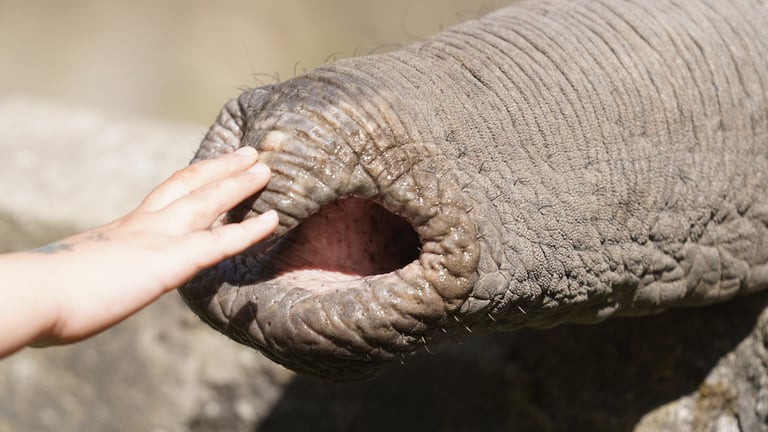


The elephant’s trunk whiskers show a functional stiffness gradient, moving from a stiff base to a soft tip to enable precise sensing of contact along each whisker.
This embodied intelligence in natural sensing highlights cross-disciplinary potential for tactile sensing in both understanding animal neuroscience and advancing robotic systems.
researchers describe the phenomenon as embodied intelligence, comparing elephant trunk whiskers to cat whiskers and noting a contrast with uniform stiffness seen in rodent hairs.
The study provides observational details of trunk use, including snuffling to detect ground vibrations, solving puzzles, tool-like behaviors, and social or comforting actions, illustrating multifunctionality.
Functional gradients appear widespread in biology and could inspire new engineering designs and biomimetic technologies.
Interviews and quotes capture cross-disciplinary motivation and a serendipitous discovery using a 3D-printed whisker wand to illustrate contact sensing.
Published in Science, the study used 3D-printed enlarged artificial trunk hairs and computer simulations to validate the findings, with tip hairs about 3–5 cm and base hairs up to 20 cm.
The team reinforced findings by 3D printing enlarged artificial trunk hairs and running simulations to confirm the observed mechanics.
Rats employ a rich whisker system with a scanning sensorimotor setup that enables texture analysis, pathfinding, pattern recognition, and object localization through active whisker movement.
The multidisciplinary team from MPI-IS, Humboldt University of Berlin, and University of Stuttgart, led by Andrew Schulz and Katherine Kuchenbecker, published the findings in Science on functional gradients facilitating tactile sensing in elephant whiskers.
The study notes potential applications for sensitive gripping in robotic systems and underscores the leadership of Schulz and Kuchenbecker.
Contributions spanned neuroscience and materials science across several institutions, underscoring a broad collaborative effort.
Summary based on 9 sources
Get a daily email with more Science stories
Sources

The Washington Post • Feb 12, 2026
Scientists have discovered one of elephants’ most sensitive secrets
Ars Technica • Feb 12, 2026
Unique structure of elephant whiskers give them built-in sensing "intelligence"
Scientific American • Feb 12, 2026
Elephants' peculiar whiskers help them sense the world around them