AI Breakthrough: DTCS Revolutionizes Real-Time Chemical Analysis, Cuts Interpretation from Weeks to Minutes
February 17, 2026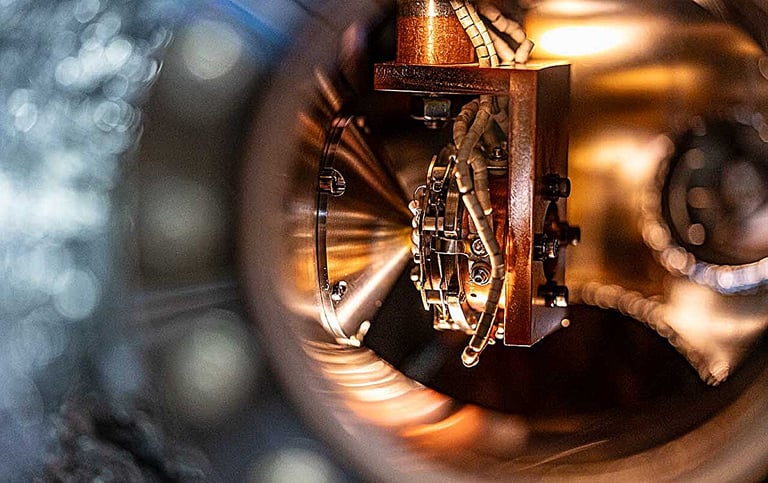


A Lawrence Berkeley National Laboratory project, the Digital Twin for Chemical Science (DTCS), uses AI to accelerate interpretation of complex chemical measurements from weeks to minutes, enabling real-time observation, parameter adjustment, and hypothesis validation within a single experiment.
DTCS links experimental APXPS spectra with physics-based simulations through forward and inverse loops, using computational resources at NERSC to power the platform.
The study detailing DTCS appears in Nature Computational Science by Jin Qian and colleagues, presenting a water-Ag(111) case study to illustrate the approach.
DTCS creates a digital replica of ambient-pressure X-ray photoelectron spectroscopy (APXPS) techniques to analyze surface chemistry on operating devices like batteries in real time.
In tests, DTCS modeled a silver/water catalytic interface relevant to batteries and catalysis, accurately predicting when and where oxygen-containing species appear on the silver surface within minutes and aligning with established results.
The platform integrates digital twins with APXPS at the Advanced Light Source to generate real-time, physics-based simulations that mirror experimental data and forecast future reaction behavior.
DTCS is envisioned as a step toward autonomous chemical characterization, with DTCS 2.0 planned to add Raman and infrared spectroscopy and broaden access to researchers at multiple facilities.
The project relies on resources from NERSC and ALS APXPS instrumentation, signaling a major leap in interfacial chemistry insights and autonomous experimentation.
DTCS operates with two connected loops: a forward loop that matches simulated spectra to experiments and an inverse loop that infers chemical mechanisms and kinetic parameters for on-the-fly hypothesis testing and planning.
DOE Office of Science and Berkeley Lab support underscores a collaborative effort involving ALS, NERSC, and other programs to accelerate discovery through digital twins in chemical science.
The platform is built atop APXPS at the Advanced Light Source and leverages NERSC computing to rapidly connect theory and experiment.
DTCS promises rapid, data-driven feedback during experiments, potentially reducing interpretation cycles and accelerating progress in energy storage, catalysis, and materials science.
Summary based on 3 sources
Get a daily email with more AI stories
Sources

Berkeley Lab News Center • Feb 17, 2026
Science on the Double: How an AI-Powered ‘Digital Twin’ Accelerates Chemistry and Materials Discoveries