Microsoft's Project Silica: Glass Data Storage Breakthrough Promises 10,000-Year Longevity
February 18, 2026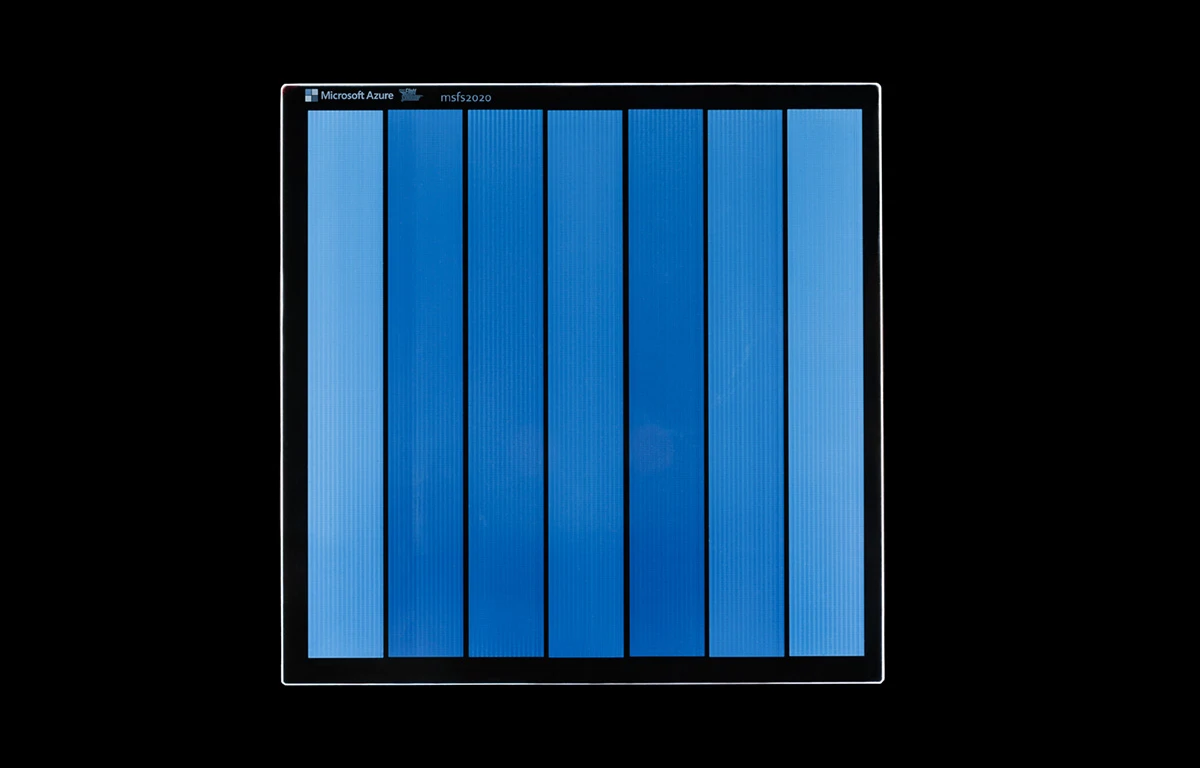


Microsoft’s Project Silica has advanced to a practical point where laser-etched borosilicate glass could store high-density data for potentially 10,000 years, marking a major step toward durable archival storage.
In tests, 4.8 terabytes were stored across 301 layers in a small glass piece, written at about 3.13 MB/s, prioritizing longevity over peak throughput.
Data is inscribed as voxels inside the glass with ultra-fast lasers; readout uses automated microscopy and an AI-based decoder to translate patterns back into information.
Challenges remain in scaling write throughput, manufacturing at scale, and creating an affordable ecosystem of plates and readers for broader use.
The report situates this work within broader research trends by referencing related Nature News & Views items and ongoing archival storage development.
Notable improvements include parallel high-speed writing with a multi-beam setup, simpler readers requiring only one camera, and streamlined writing devices for easier manufacturing.
The article frames glass storage as a potential durable, maintenance-free archival solution amid the limits of magnetic tape and conventional hard drives, suggesting multiple archival strategies may be needed.
Experts caution about economic feasibility and long-term reader availability, emphasizing that durability must be balanced with practical considerations.
Future scaling aims to optimize voxel pitch, boost numerical aperture, use higher-repetition-rate lasers and spatial multiplexing, and explore different glass compositions and read/write hardware trade-offs.
Nature publication highlights advances like birefringent and phase voxels, pseudo-single-pulse writing, enhanced parallelism, and machine learning for encoding and error management.
The effort emphasizes co-design of hardware and software from media to cloud APIs, including a low-power media library and robotics considerations for archival storage systems.
Authors declare no competing interests.
Summary based on 24 sources
Get a daily email with more World News stories
Sources

Microsoft Research • Feb 18, 2026
Project Silica’s advances in glass storage technology
The Guardian • Feb 18, 2026
Stone, parchment or laser-etched glass? Scientists find new way to preserve data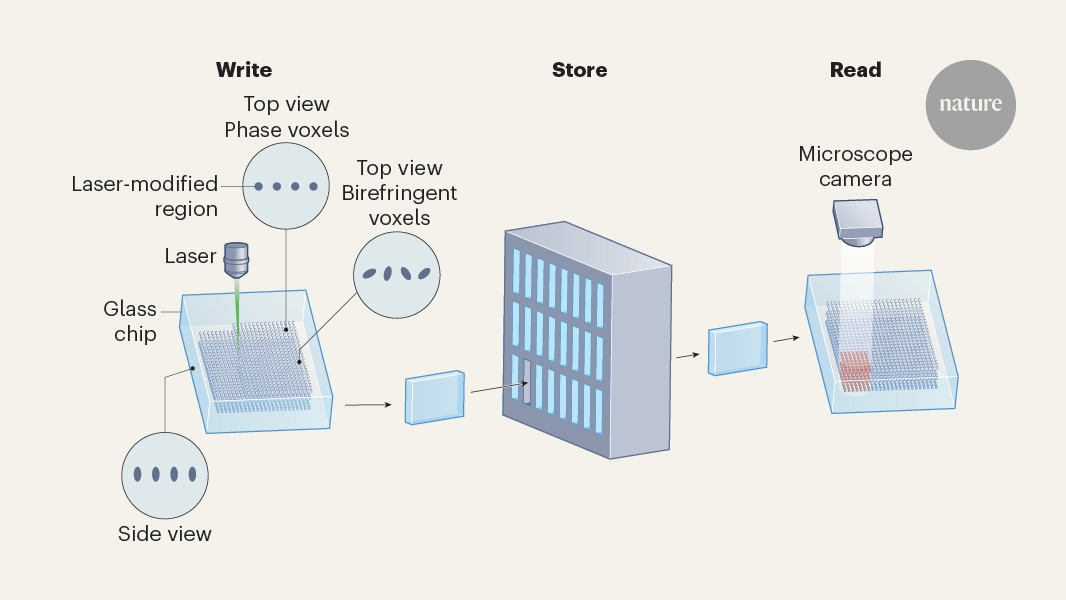
Nature • Feb 18, 2026
Laser-written glass tablets can preserve data for millennia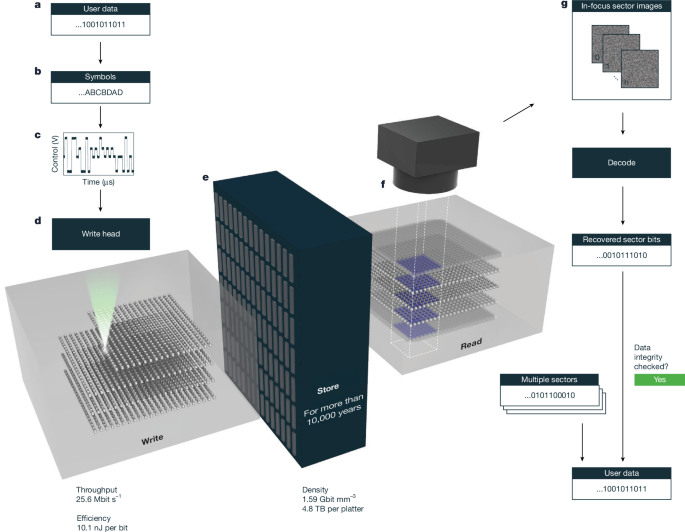
Nature • Feb 18, 2026
Laser writing in glass for dense, fast and efficient archival data storage