China Launches Ambitious MACE Experiment to Break New Ground in Leptonic Physics
February 2, 2026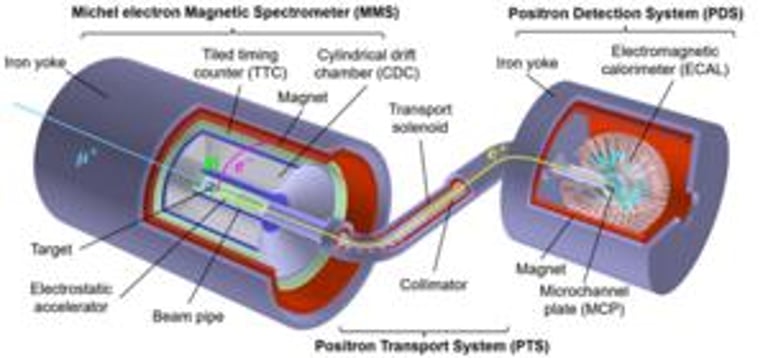

A new experiment named MACE (Muonium Antimuonium Conversion Experiment) aims to search for spontaneous muonium-to-antimuonium conversion, which would violate lepton flavor conservation and point to new physics beyond the Standard Model.
Led by researchers from Sun Yat-sen University and the Institute of Modern Physics (Chinese Academy of Sciences) with collaborators in China, MACE offers a unique probe of ΔL = 2 processes in leptonic physics.
If successful, the discovery would open a window to new leptonic physics and access energy scales between 10 and 100 TeV, potentially rivaling future collider reach; Phase I will also study other rare muonium decays and lepton-flavor-violating processes such as M → γγ and μ → e γ γ.
The article describing the conceptual design was published in Nuclear Science and Techniques on January 28, 2026, with the full study available via DOI 10.1007/s41365-025-01876-0.
Beyond fundamental physics, the technologies developed for MACE—muonium production targets, low-energy positron transport, and high-resolution detectors—could find broader applications in materials science and medical research.
MACE is part of China’s broader push to advance high-precision nuclear and particle physics infrastructures and to foster international collaboration and technological innovation.
MACE aims to improve sensitivity over the 1999 limit by more than two orders of magnitude, targeting conversion probabilities around 10^-13 through a high-intensity surface muon beam, a novel silica aerogel target, and refined detectors.
Ultimately, MACE is framed as a new window into fundamental laws, with every component optimized to explore physics that could redefine our understanding of matter, symmetry, and the universe.
Summary based on 2 sources
Get a daily email with more Science stories
Sources

ScienceDaily • Feb 2, 2026
Scientists are hunting for a forbidden antimatter transformation
EurekAlert! • Jan 30, 2026
A 100-fold leap into the unknown: a new search for muonium conversion into antimuonium