Smartwatch Study Aims to Curb Opioid Misuse by Monitoring Heart Rate Variability
February 2, 2026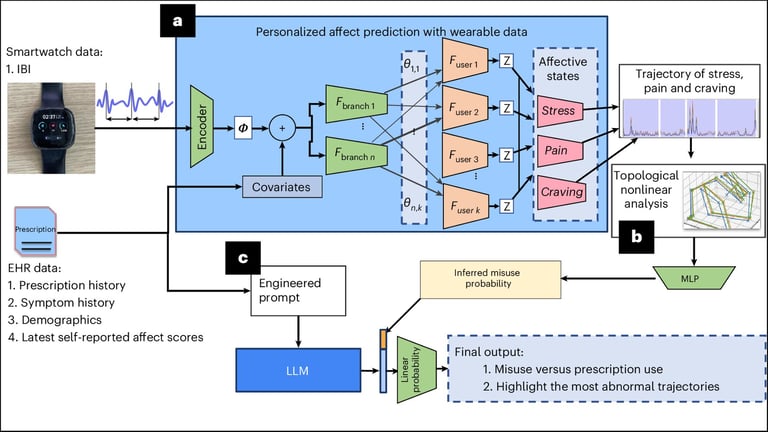

Researchers personalized predictions by training individualized models and using a learning-to-branch approach to identify clusters with similar characteristics, avoiding a one-size-fits-all predictor.
The research is published in Nature Mental Health (2026) under the title Personalized entropy-informed deep learning for identifying opioid misuse, with DOI 10.1038/s44220-025-00555-8.
Risk of opioid misuse was estimated by analyzing the shape of daily patterns over time with nonlinear dynamical analysis, finding that higher-risk individuals showed more repetitive, less flexible trajectories (lower entropy) than those prescribed opioids as directed (higher entropy).
A UC San Diego–led study proposes using a consumer smartwatch to continuously monitor heart rate variability as a biomarker for stress, pain, and craving in people with chronic pain on long-term opioid therapy, aiming to detect high-risk states for opioid misuse before crises occur.
Clinical context from medical records, including demographics, prescription history, symptoms, and related conditions, was incorporated via compact numerical summaries generated by clinically trained language models to improve prediction accuracy.
The combined smartwatch data and medical context improved the model’s performance, enabling earlier detection of risk shifts between clinic visits and potentially triggering timely, just-in-time interventions.
The study collected 10,140 hours of wearable data from 51 adults over eight weeks using a Garmin Vivosmart 4 to track inter-beat intervals and derive HRV as a window into the nervous system’s response to stress.
The study envisions ongoing monitoring to support proactive interventions rather than periodic, crisis-oriented checks, with the goal of reducing overdose risk and improving care for chronic pain patients on opioids.
Summary based on 1 source
Get a daily email with more Science stories
Source
Medical Xpress • Feb 2, 2026
Before crisis strikes—smartwatch tracks triggers for opioid misuse