Sea Stars' Brain-Free Locomotion Inspires Next-Gen Soft Robotics
February 8, 2026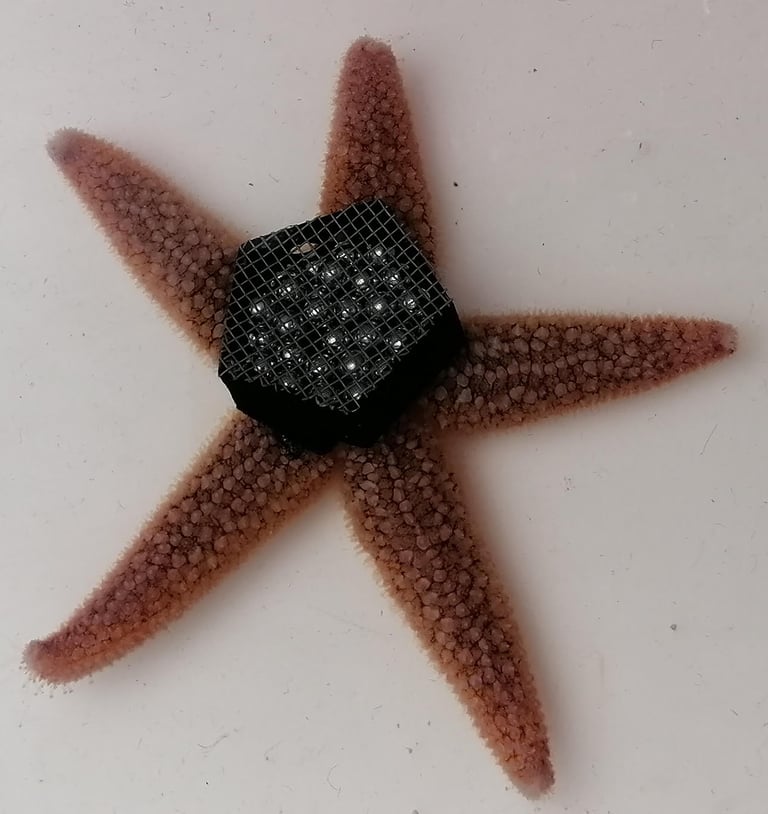


Increasing load or crawling upside down increases adhesion time and slows movement, underscoring that locomotion is driven by local foot dynamics rather than brain-driven coordination.
The team, including Eva Kanso and collaborators from UC Irvine and SYMBIOSE Lab, used a 3D-printed backpack to load weights and study foot responses to validate the distributed-control hypothesis.
Coordinated, larger-scale behavior emerges from local rules and mechanical feedback, implying complex adaptation without a central controller—relevant to soft robotics.
Robotic takeaways include designing soft, multi-contact systems that can navigate uneven, vertical, inverted, or disconnected terrain without reliable central communication.
Key authors, including Eva Kanso, published the findings in PNAS in 2026 under the title Tube feet dynamics drive adaptation in sea star locomotion.
Robustness comes from mechanical linkage and redundancy among tube feet, enabling continued locomotion despite local failures.
FTIR imaging visualizes tube foot contact, adhesion, and detachment in real time to measure how many feet are attached and for how long.
A mathematical model shows simple local rules coupled with body mechanics can yield robust, coordinated movement without a centralized controller.
Sea stars move with hundreds of tube feet guided by a distributed nerve net and local mechanical interactions, without a centralized brain.
Experiments show sea stars can keep moving when overturned, as each foot locally senses gravity and mechanical cues independent of a brain.
USC’s Kanso Bioinspired Motion Lab studies decentralized control from hundreds of tube feet, each adjusting adhesion based on local cues rather than a central processor.
Movement proceeds in three stages—attachment, adhesion, and detachment—with speed governed by contact time, since longer adhesion slows overall motion.
Summary based on 2 sources
Get a daily email with more Tech stories
Sources
Forbes • Feb 8, 2026
How To Walk Without A Brain
Tech Xplore • Feb 7, 2026
Robots that keep moving when flipped? Sea star tube feet offer a blueprint