Newly Discovered Exoplanet Boasts Perpetual Magma Ocean and Sulfurous Atmosphere
March 16, 2026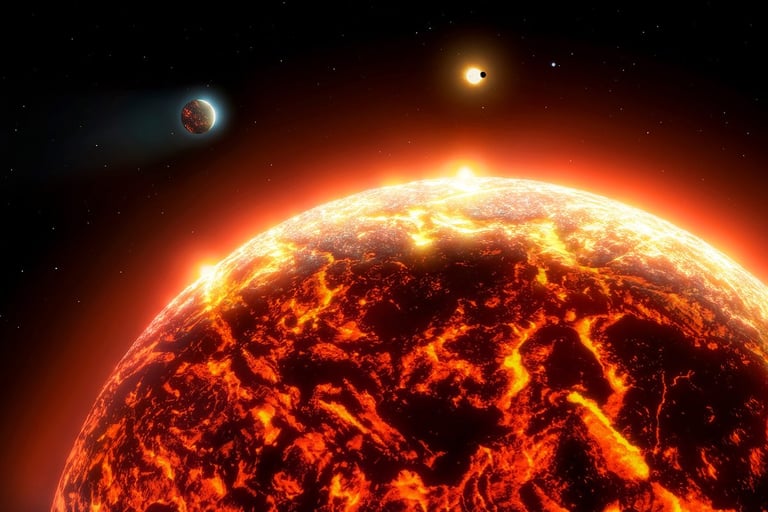


A newly studied exoplanet, L 98-59 d, orbits a red dwarf about 34 light-years away in Volans and hosts a perpetual magma ocean beneath a thick, sulfur-rich atmosphere.
The study suggests L 98-59 d may be the first known member of a broader class of gas-rich, sulfurous planets, with more such worlds likely existing elsewhere.
L98-59 d is about 1.6 times the size of Earth and may be a molten lava world rather than a rocky or water world.
Its atmosphere is thought to be rich in hydrogen sulfide, contributing to a sulfurous odor and making the environment extremely hostile to life as we know it.
Extreme surface conditions, with temperatures exceeding 1,500 C (2,732 F), and a sulfur-rich interior imply a mineralogical composition different from Earth.
The magma ocean could efficiently store and release gases, helping explain the planet’s long-lived sulfur-rich atmosphere and challenging ideas about habitability in the traditional habitable zone.
Observations in 2024 detected sulfur dioxide and other sulfur gases in the atmosphere, prompting reconstruction of its geological and atmospheric history.
Modeling shows scientists can infer the planet’s deep interior history from observable data like size, mass, and atmospheric composition, revealing interior processes not directly accessible.
Surface temperatures are estimated around 1,900 C (3,500 F) with a molten core and widespread magma on the surface.
Initial expectations of a global ocean are replaced by a finding of a mostly molten state rather than a water-based ocean.
Computer simulations trace L 98-59 d’s nearly five-billion-year history, showing a global magma ocean with a molten silicate mantle that traps and releases sulfur compounds into the atmosphere over time.
Magma-driven planetary waves may be caused by gravitational interactions with neighboring planets, creating dynamic surface activity.
Summary based on 5 sources
Get a daily email with more World News stories
Sources

The Guardian • Mar 16, 2026
‘A molten, mushy state’: scientists may have found a new type of liquid planet
Yahoo News • Mar 16, 2026
Molten alien planet with sulfur-choked atmosphere displays unique hellscape
Gizmodo • Mar 16, 2026
This Alien Planet Might Be the Stinkiest Place in the Galaxy
Space • Mar 16, 2026
Astronomers discover a new type of planet that probably smells like rotten eggs