New Study Uncovers Brain's Role in Chronic Pain and Anxiety, Reveals Potential Treatment Target
March 2, 2026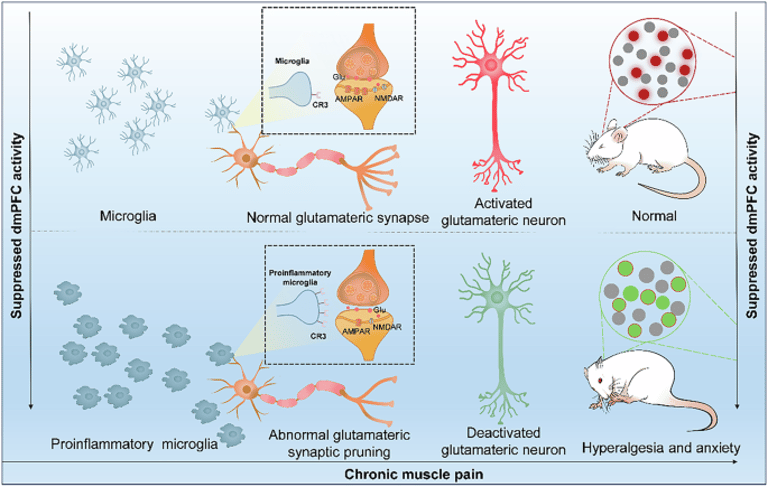

The dmPFC activity trajectory shifts from early hyperactivity in CMP to chronic hypoactivity (about two weeks and beyond), with reduced glutamatergic signaling that correlates with higher pain and anxiety.
Synaptic structure in CMP changes over time: initial synapse increases are followed by decreases, and later stages show thinner PSDs, indicating remodeling and impaired dmPFC plasticity.
Chronic muscle pain (CMP) is driven by microglial CR3-dependent synaptic pruning in the dmPFC, which suppresses glutamatergic neuron excitability and contributes to ongoing pain and anxiety-like behaviors.
Manipulating the dmPFC shows a causal role: activating dmPFC glutamatergic neurons reduces mechanical allodynia and anxiety-like behavior, while inhibiting the dmPFC worsens pain, suggesting a protective role for dmPFC excitation.
Overview: CMP involves emotional comorbidity and central mechanisms, with the dmPFC playing a key role in affective pain processing through synaptic plasticity and glial interactions.
Targeting microglial CR3-mediated pruning offers a potential therapeutic avenue to treat CMP and its affective comorbidities by restoring dmPFC glutamatergic function and normal pain circuitry.
Model and methods: CMP is modeled in rats via gastrocnemius hypertonic saline; the study used optogenetics, chemogenetics, electrophysiology, imaging, single-cell sequencing, and behavioral assays to dissect dmPFC function and microglial involvement.
Knockdown of microglial CR3 reverses synaptic plasticity deficits, restores excitatory neuronal activity, and attenuates both pain and emotional symptoms.
dmPFC interacts with vlPAG and spinal dorsal horn; activating dmPFC dampens spinal dorsal horn hyperexcitability via a dmPFC→vlPAG→SDH pain-control pathway.
Summary based on 1 source