Microscopic QR Code: Guinness World Record for Tiny, Durable Data Storage on Ceramic
March 29, 2026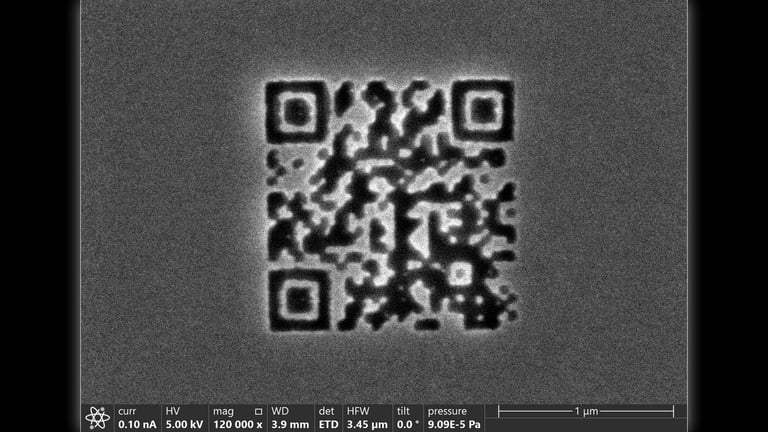


The project emphasizes durability and independence from power, drawing inspiration from enduring ancient inscriptions.
The team’s achievement has been officially recognized by Guinness World Records for the tiny size and durability of the data storage method.
Long-term data preservation is envisioned, with the method potentially lasting hundreds to thousands of years without energy input to maintain data.
The approach promises extremely high data density, with more than 2 terabytes potentially stored in the area of a single A4 sheet, aiming for durability under extreme conditions.
A microscopic QR code, measuring 1.98 square micrometers with each pixel at 49 nanometers, is far smaller than most bacteria and invisible under visible light, though readable with electron microscopy.
TU Wien researchers and Cerabyte engraved the QR code into ultra-stable ceramic materials, making it visible only under an electron microscope.
Ceramic data storage is pitched as a sustainable, long-lasting solution requiring minimal energy and maintenance, potentially enduring centuries or millennia.
The ceramic medium is presented as a durable alternative to magnetic and electronic media, reducing energy use and cooling needs for long-term archiving.
The achievement has earned official global recognition as a Guinness World Records entry, highlighting both the small scale and durability of the storage method.
Future work includes testing other materials, increasing writing speeds, and developing scalable manufacturing processes to move beyond laboratory settings.
Plans also cover expanding beyond QR codes to more complex data structures in ceramic thin films and broader industrial applications.
A core challenge addressed is data stability at the nanoscale, where atomic movement can erase information; the ceramic method yields a stable, repeatedly readable code.
Summary based on 2 sources
Get a daily email with more Tech stories
Sources

Slashdot • Mar 29, 2026
World's Smallest QR Code - Smaller Than Bacteria - Could Store Data for Centuries - Slashdot
ScienceDaily • Mar 29, 2026
World's smallest QR code, smaller than bacteria, could store data for centuries