Unlocking Brain Aging: ATP11B's Role in Iron Mishandling and Mitochondrial Dysfunction
April 20, 2026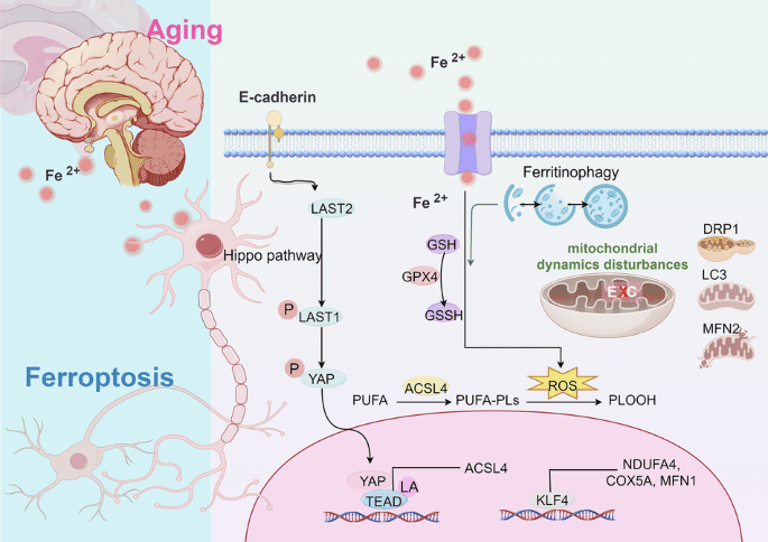

Neuronal mitochondrial dysfunction drives ferroptosis signaling, with downstream shifts in iron-handling genes (TFR, FTH1, NCOA4) and lipid peroxidation pathways.
Loss of ATP11B triggers a metabolic shift: oxidative phosphorylation declines while glycolysis rises, accompanied by higher lactate and compensatory ECAR/OCR changes, signaling mitochondrial dysfunction and energy stress.
Neuronal ferroptosis markers rise with ATP11B loss, including lipid peroxidation and weakened antioxidant defenses (lower GSH with altered GSH/GSSG and NADPH/NADP+), plus increased MDA, ACSL4 and GPX4 pathway alterations, and elevated free Fe2+.
ATP11B deficiency undermines mitochondrial quality control, reducing expression of respiratory chain genes (Cox5a, Ndufa4, Ndufb6), lowering complex I/IV activity, dropping mitochondrial membrane potential, and promoting fragmentation and vacuolization.
Single-cell and spatial data show ATP11B is enriched in choroid plexus, hippocampus, and cortex; loss of ATP11B weakens tight junctions, raises BBB permeability, and increases Fe2+ in hippocampus and cortex.
Behavioral and cognitive deficits accompany ATP11B deficiency, including memory and social impairments and reduced survival, aligning with increased Fe2+, BBB disruption, and neuronal damage.
Ependymal cells around the hippocampus may ferry iron to neurons in Atp11b-/- mice, contributing to ferroptosis susceptibility in hippocampal neurons.
Key brain aging regulator ATP11B governs iron handling and mitochondrial health: its deficiency drives iron (Fe2+) transport to hippocampal neurons, disrupts mitochondrial respiration and dynamics, and activates neuronal ferroptosis, accelerating aging.
Exploring the ATP11B-YAP axis, researchers are tracing its impact on brain aging, mitochondrial function, and ferroptosis with potential links to age-related cognitive decline.
Therapeutic angle: boosting ATP11B expression rescues memory performance and reverses neuronal ultrastructural degeneration, highlighting ATP11B as a target to interrupt iron mishandling, mitochondrial dysfunction, and ferroptosis in aging brains.
Summary based on 1 source