Cygnus X-1 Black Hole Jets Measured in Real-Time: A Leap Forward for Astronomy
April 20, 2026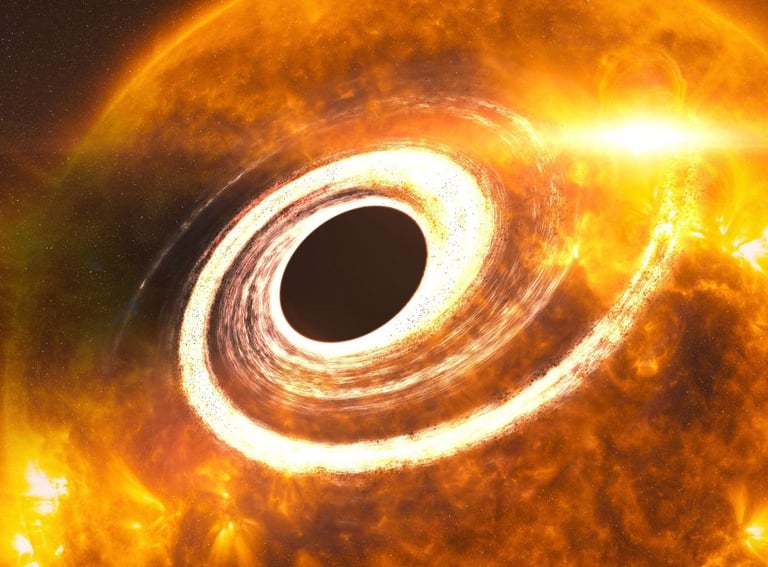

Cygnus X-1, the first confirmed black hole, emits powerful jets whose instantaneous power and speed have been measured in real time using a network of Earth-based radio telescopes, marking a major leap from long-term averages.
Astronomers used the wind from its supergiant companion and archival data to determine that roughly 10 percent of the energy released by matter falling into the black hole is channeled into the jets, aligning with long-standing theories.
The jets travel at about half the speed of light, with their energy output equivalent to the luminosity of around 10,000 suns, underscoring the jets as a dominant energy channel for the system.
This real-time measurement provides an empirical anchor for accretion physics and jet energetics, facilitating calibration of simulations across black holes of different masses.
The analysis accounts for the deflection of jets by the stellar wind from the companion, enabling precise determination of jet strength in the moment.
The findings establish a practical benchmark for black hole feedback applicable to larger supermassive black holes and set the stage for interpreting jets in distant galaxies.
Published in Nature Astronomy, the study has implications for galaxy evolution and will support future observations with next-generation radio facilities like the Square Kilometre Array.
The research offers a calibration method for simulations and aims to map how black holes drive shocks, turbulence, and structural changes in the universe.
The jet power and speed were inferred from the interaction with the companion star's wind, which bent the jets and provided measurable cues.
Observations indicate the jet energy corresponds to roughly 10,000 solar luminosities and the jets reach speeds near 355 million miles per hour (about 150,000 km/s).
The work was led by Curtin University’s CIRA and the Curtin node of ICRAR, with collaborators from Oxford and several universities, reflecting a wide international collaboration.
Looking ahead, the study's methods and results could guide observations with the SKA and similar facilities, enhancing understanding of jet physics across the cosmos.
Summary based on 5 sources
Get a daily email with more Science stories
Sources
The Times Of India • Apr 20, 2026
62 years later, the first known black hole is unleashing energy equal to 10,000 Suns
Los Angeles Times • Apr 20, 2026
Astronomers measure the power and speed of black hole jets for the first time - Los Angeles Times
ScienceDaily • Apr 18, 2026
Black hole jets measured for first time and rival the power of 10,000 suns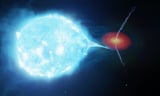
Talker • Apr 17, 2026
Astronomers measure black hole jet power for first time