Harnessing Formal Verification: A Strategic Approach to Reduce Programme Risk and Enhance Efficiency
April 21, 2026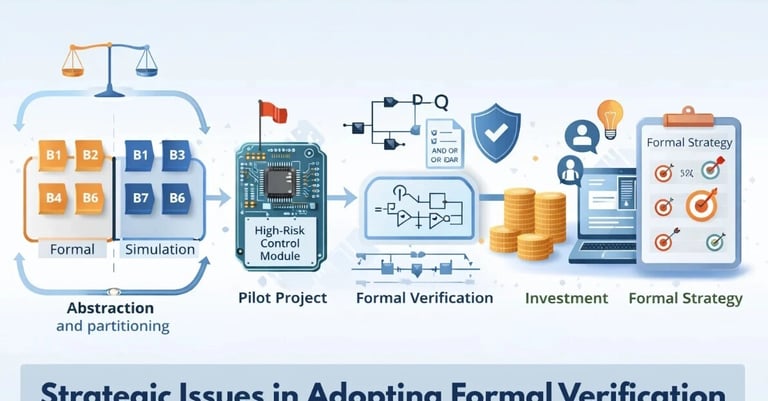

The conclusion stresses that success hinges on placing formal verification within the programme, integrating it with simulation, and building a credible, selective capability rather than aiming to universally replace simulation.
Strategic pilots should test formal methods on high-risk control and protocol logic, begin soon after RTL stability, keep the scope tight to well-suited domains, and develop reusable assertions and models to sustain long-term benefits.
A mutually-exclusive deployment model or partitioning helps manage complexity by labeling design blocks as formal-friendly or simulation-friendly, guiding where formal analysis adds the most value.
Adoption is constrained by workforce skills, culture, and structure, necessitating training in temporal logic, abstraction, and proof interpretation, along with broader cultural shifts in how progress and completeness are measured.
The economic value of formal verification rests on selective, early use; upfront tool investments are offset by fewer late-stage defects, reduced silicon re-spins, and faster debugging, especially in safety-critical areas.
Formal verification is framed as a strategic shift, not a simple tool upgrade, requiring organization-wide decisions on where, when, and how to apply formal methods to lower overall programme risk.
Adoption requires early, formal-ready environments, centralized assertion management, and alignment with development processes (Agile/CI-CD/V-model), ensuring assertion reuse and stable RTL before formal work.
To handle state-space growth, promote a formal–simulation split: formal targets control logic, interfaces, and protocol handling while simulation covers datapath-heavy logic through deliberate abstraction and partitioning.
Successful workflows must integrate formal methods with simulation in a unified flow, exercising assertions in simulation, proving them formally, and reusing them as directed simulation tests for broader scenario coverage.
Summary based on 1 source
Get a daily email with more Tech stories
Source

DEV Community • Apr 21, 2026
Strategic Issues in Adopting Formal Verification