Sony's AI-Powered Robotic Arm Challenges Table Tennis Pros with Cutting-Edge Technology
April 22, 2026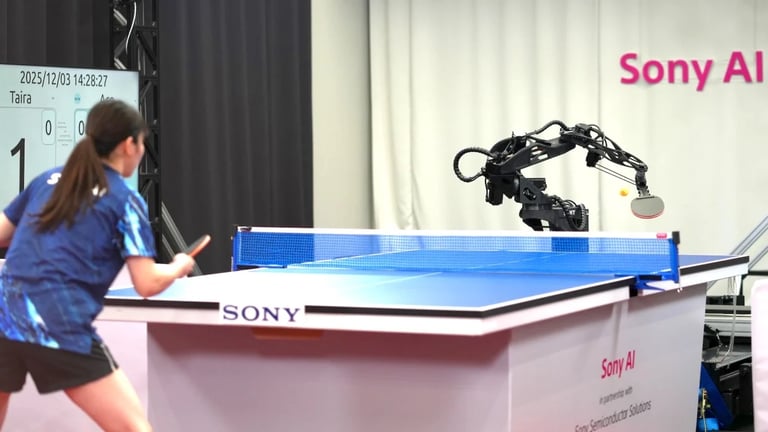


Ace, Sony’s robotic arm, demonstrated expert-level table tennis play against professional athletes using reinforcement learning, marking a notable advance in AI and robotics.
The system blends nine cameras with three custom event-based sensors to detect changes in the image, delivering ball position data at 200 Hz and ball rotation data at up to 700 Hz.
Developers emphasize speed, perception, and adaptive strategy, aiming to match skilled humans rather than merely hitting balls faster.
Related materials point to Global Shutter Image Sensor and Event-based Vision Sensor product pages for additional context.
Key challenges include high development costs and safety protocols for human-robot interactions, with proposed solutions such as fail-safes and simulation-based testing.
Experts say demonstrations are valuable for studying human motor behavior, but real-world utility requires multi-task capabilities, safer control, faster adaptation, and better perception of human partners.
Regulatory and ethical considerations include AI ethics compliance and transparency to ensure technology augments rather than replaces human coaches.
Skepticism exists about practical applicability; some argue the approach is highly specialized to table tennis and may not generalize, advocating for more versatile, adaptable robots.
Market and monetization ideas include licensing to sports brands, subscription-based coaching, and cloud-based AI updates to address scalability and energy efficiency.
There are concerns about broader security implications of such speed and decision-making capabilities, including potential military use where rapid perception and action could be consequential.
Early iterations focused on perception, hardware tuning, and physical modeling, requiring years of development from 2020 to 2025.
Researchers see ongoing potential in real-time opponent modeling and online learning to improve generalization to human adversaries.
Summary based on 71 sources
Get a daily email with more Startups stories
Sources

Mashable • Apr 22, 2026
AI ping pong robot beats top human players, but don’t freak out yet
AP News • Apr 22, 2026
A robot Sony built with AI is defeating human pros at table tennis | AP News

Outlook India • Apr 23, 2026
Robots Vs Humans: Sony’s Table Tennis Robot ‘Ace’ Emerges As New AI Star Challenging Human Dominance