289-Million-Year-Old Fossil Reveals Earliest Known Rib-Based Breathing in Amniotes
April 27, 2026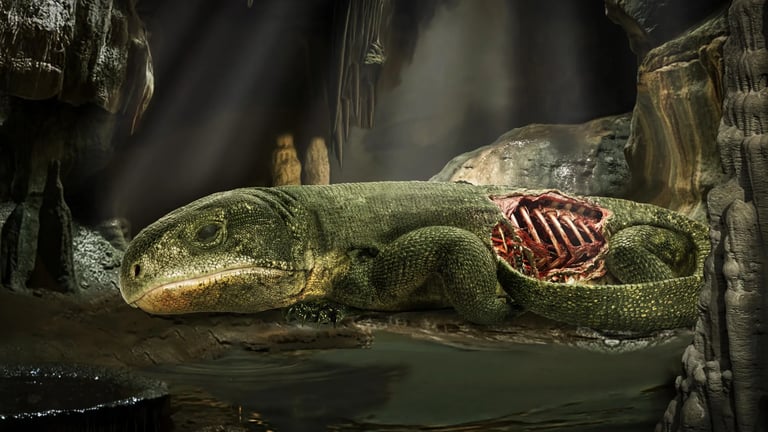

Three-dimensional preservation of skin with an accordion-like texture and three fossil specimens enabled researchers to reconstruct the organism’s breathing system.
A 289-million-year-old Captorhinus aguti fossil from Richards Spur, Oklahoma, preserves soft tissues, skin, cartilage, and proteins, representing the earliest known rib-based breathing in amniotes.
The fossil preserves protein remnants in bone, cartilage, and skin, pushing back the preservation limit of soft tissues by nearly 100 million years and revealing ancient biomolecules previously unknown in fossils.
Rib-based ventilation likely represents the ancestral breathing mode for reptiles, birds, and mammals, enabling more active lifestyles and terrestrial diversification for amniotes.
Analysis of three specimens identified a segmented cartilaginous sternum, sternal ribs, intermediate ribs, and connections linking the ribcage to the shoulder girdle, supporting a costal (rib-based) breathing mechanism.
The fossils are housed at the Royal Ontario Museum in Toronto and will remain available for ongoing study, with researchers from institutions including Harvard and the University of Toronto expanding our understanding of early reptile evolution and land life.
Neutron computed tomography revealed skin wrapping and an accordion-like scaly pattern, indicating advanced integumentary features similar to modern worm lizards.
Summary based on 2 sources
Get a daily email with more Science stories
Sources

SciTechDaily • Apr 26, 2026
289-Million-Year-Old Reptile Mummy Reveals Origin of Human Breathing System
ScienceDaily • Apr 23, 2026
289-million-year-old mummified reptile reveals how breathing began on land