Breakthrough: KAUST's MOF Nanoparticles Turn Cells into Drug Factories with Protein Pathway Transplants
May 18, 2026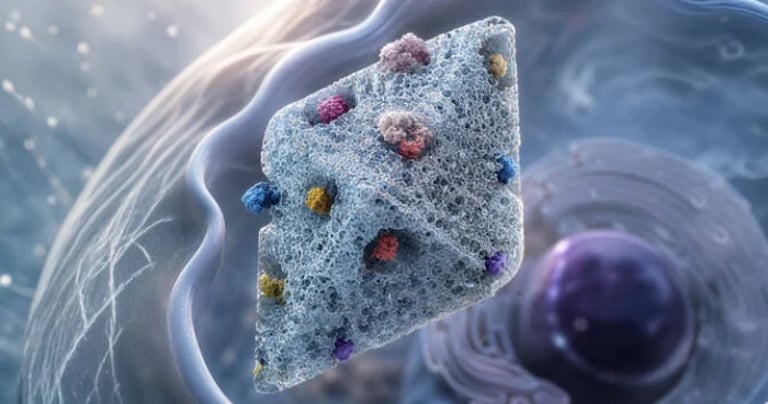

A key technical advance involved engineering a more porous, sponge‑like MOF framework to preserve protein activity and enable single‑unit delivery of the integrated protein system.
The achievement reflects a crucial interdisciplinary collaboration between biology and materials science, driving progress in this therapeutic approach.
The platform is adaptable and programmable, allowing fine‑tuning of protein interactions inside cells to create disease‑specific therapies with the goal of minimizing off‑target effects.
Published in Advanced Materials, the work combines nanotechnology, materials science, and bioengineering to address delivering multiple proteins simultaneously into cells.
The study envisions future therapies that produce treatment compounds directly at disease sites, potentially reducing side effects on healthy tissue.
KAUST researchers have developed porous metal‑organic framework (MOF) nanoparticles that carry six proteins into living mammalian cells, effectively acting as a tiny, intracellular drug factory.
Encapsulated within MOFs, the six proteins form a coordinated system that mimics natural organelles, aiming to produce therapies directly within diseased tissue.
Inside the cells, the six proteins act in sequence to convert an amino acid into violacein, representing the most complex multiprotein system delivered into living cells to date and the first ‘protein pathway transplant.’
The researchers emphasize the approach is in early stages, with plans to validate in animal models to assess therapeutic potential before clinical use.
Summary based on 2 sources
Get a daily email with more Science stories
Sources
ARY News • May 16, 2026
KAUST scientists develop nanoscale drug factory inside living cells
VOI.ID • May 18, 2026
KAUST Scientists Create a Mini 'Drug Factory' Inside Living Cells