Study Suggests Amaterasu Particle May Be Ultra-Heavy Nucleus, Rethinking Cosmic Ray Origins
May 31, 2026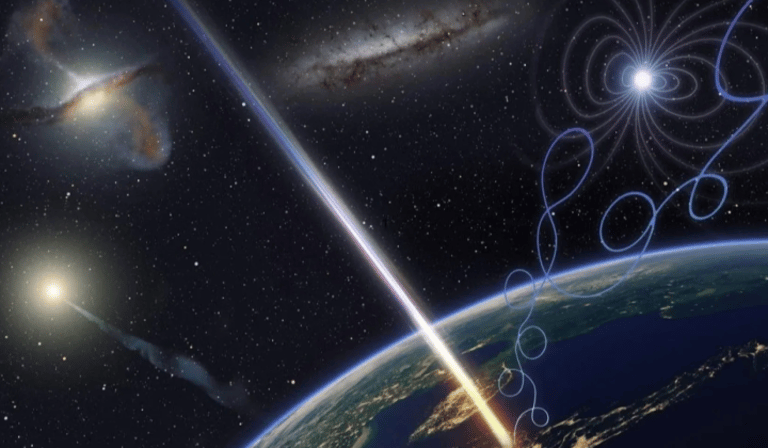

Key future investigations include Argentina’s AugerPrime Observatory and a global cosmic ray tracking network to test the heavy-nucleus hypothesis.
A Pennsylvania State University study argues the Amaterasu particle detected in Utah in 2021 is likely a heavy-element nucleus rather than a light one, potentially explaining its odd path through space as it interacts with intergalactic magnetic fields.
Simulations show the Amaterasu nucleus would carry a kinetic charge comparable to the speed of a professional tennis ball, marking progress in understanding ultra-high-energy cosmic rays.
The 2021 Utah detection involved kinetic energy akin to a tennis serve, with models suggesting ultra-heavy nuclei can slowly release energy in vacuum, which could account for its unusual trajectory.
These findings could reshape theories about the origins and nature of cosmic rays, with wide implications for astronomy and particle physics and prompting deeper study of how elementary particles interact with the cosmic environment.
Beyond cosmic rays, the piece briefly covers recent geological work on Earth's core, including observed flow reversals beneath the Pacific, with a related link for further reading.
Supportive projects such as AugerPrime and the Global Cosmic Ray Tracking Network are highlighted as advancing the study of ultra-high-energy cosmic rays.
The idea that intergalactic magnetic fields influence Amaterasu’s path contributes to the debate about the nature and origin of ultra-high-energy cosmic rays.
Digital simulations indicate ultra-heavy atomic nuclei may slowly exchange energy with the vacuum, offering clues about their origin and behavior in space.
If Amaterasu is a heavy-element nucleus, telescopes may have been looking in the wrong directions for cosmic-ray sources, challenging prevailing assumptions about their origins.
Project lead Kohta Murase notes that a heavy-nucleus interpretation implies misdirected searches for cosmic-ray sources, urging a reevaluation of source targets.
The Amaterasu particle’s trajectory points toward a galaxy-free region, underscoring its unusual nature compared with typical cosmic-ray sources.
Summary based on 2 sources
Get a daily email with more Science stories
Sources

Inkorr • May 31, 2026
Scientists Unravel the Mystery of the 'Amaterasu' Cosmic Particle
Inkorr • May 31, 2026
Scientists Unravel the Mystery of the Amaterasu Particle