Revolutionary MINFLUX Imaging Unveils Dynamic Chromatin Movement, Challenging Traditional Models
May 4, 2026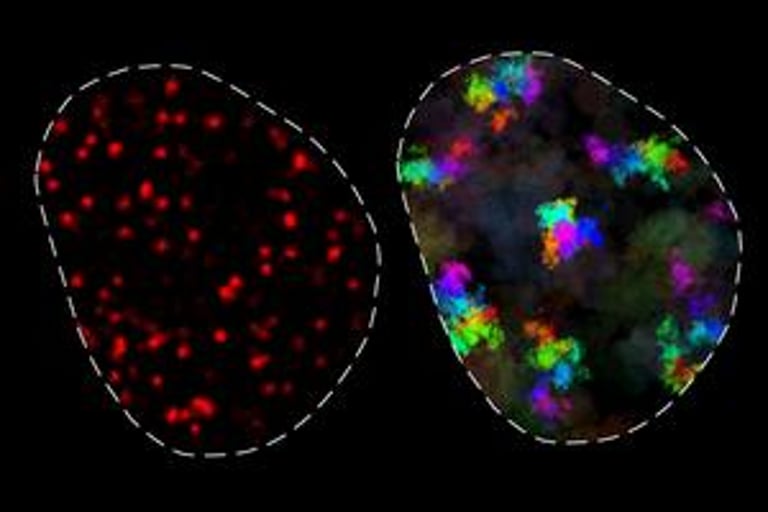

Short- to intermediate-timescale motion remains confined within roughly 200 nanometers, described as a subdiffusive region of influence that governs rapid encounters.
MINFLUX live-cell imaging represents a major methodological advance, enabling real-time, nanoscale tracking to inform models of genome organization and dynamics.
The research provides mechanistic insights into how chromatin organization regulates gene activity and genome maintenance, with implications for epigenetic regulation and DNA damage response.
Many regulatory element–gene interactions and DNA repair processes can occur via normal chromatin motion within about 100,000 base pairs, with longer-range contacts emerging only over longer timescales in certain cell types.
The study employed MINFLUX super-resolution microscopy with conventional imaging to trace chromatin motion across seven orders of magnitude in time and across several cell types.
Chromatin moves in two distinct regimes: a constrained, local motion within about 200 nanometers and a separate, freely moving regime that reaches distant regions but unfolds over longer timescales.
A second cell-type–specific class shows more extensive chromatin movement at longer timescales, indicating variability in chromatin states or nuclear environments across cell types.
The study, published May 2026 in Nature Structural & Molecular Biology, features MIT researchers and funding from NIH, NSF CAREER, Pew-Stewart, and the Bridge Project.
Findings challenge traditional chromatin models and highlight the need to consider factors like crowded nucleoplasm to explain subdiffusive dynamics, with observed heterogeneity across cell types.
These results suggest existing models (Rouse, fractal globule) may require revision to incorporate chromatin’s interactions with the crowded nucleoplasm and cell-type variability.
Researchers measured chromatin movement across seven orders of magnitude in time (from hundreds of microseconds to hours) using MINFLUX, enabling robust, wide-range dynamics analysis in living cells.
MINFLUX achieved nanometer-scale single-molecule tracking across timescales from microseconds to seconds, and, when paired with other imaging, spanned sub-millisecond to hours across multiple cell types.
Summary based on 3 sources
Get a daily email with more Science stories
Sources
EurekAlert! • May 4, 2026
MIT researchers show how chromatin movement helps control gene expression
BIOENGINEER.ORG • May 4, 2026
MIT Researchers Reveal How Chromatin Dynamics Regulate Gene Expression
Mirage News • May 4, 2026
How Chromatin Movement Helps Control Gene Expression