NASA Upgrades Cold Atom Lab on ISS to Propel Quantum Science and Space-Based Technologies
June 16, 2026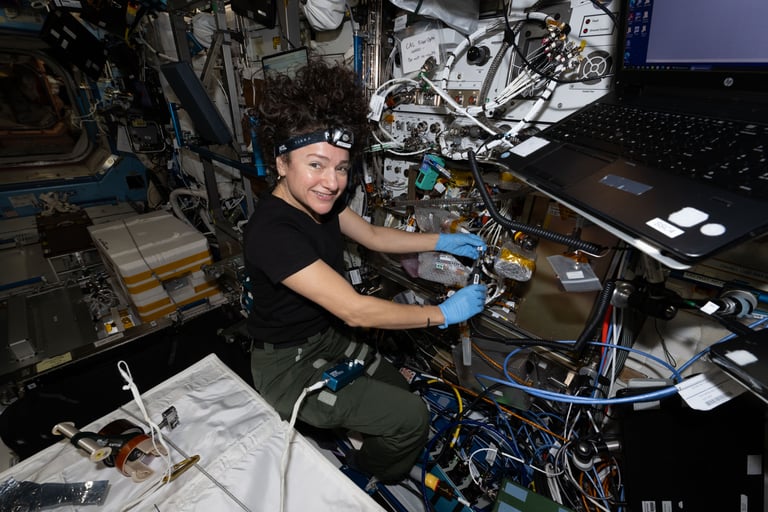

The International Space Station has upgraded NASA’s Cold Atom Lab to advance quantum science experiments in microgravity, enabling researchers to study ultracold matter and explore new quantum technologies.
Experiments use laser cooling to trap rubidium or potassium gases in a vacuum, allowing longer observation times in microgravity.
Quantum science examines matter at the smallest scales, where atoms behave as waves and can form a Bose-Einstein condensate under extreme cooling.
Project scientists emphasize this upgrade as a step toward reliable space-based quantum technology and leadership in quantum research.
Microgravity enables longer observation periods and larger quantum waves, improving precision in time, gravity, and motion measurements and allowing tests of quantum phenomena in space.
Five international teams participate in experiments, with the upgrade maturing space-readiness of quantum tools for future Earth science and space missions.
Caltech manages the Cold Atom Lab, with JPL designing, building, and operating it under NASA’s Biological and Physical Sciences division, as part of NASA’s broader science mission.
NASA provides information and mission details through its Cold Atom Lab pages and related resources.
NASA highlights the project as leadership in space-based quantum technologies and maturing instruments like matter-wave interferometers for fundamental physics missions, navigation, timing, and gravity sensing beyond Earth.
The lab cools atoms to ultracold temperatures (below -459°F / -237°C) using laser cooling and magnetic traps to create and study large quantum waves, including Bose-Einstein condensates.
The upgrade, the fourth since 2018, features a redesigned magnetic trap and new metal-strip sources, expanding the lab’s ability to generate and shape quantum gas clouds.
Summary based on 3 sources
Get a daily email with more Science stories
Sources
NASA • Jun 16, 2026
NASA’s Quantum Lab Aboard Space Station Gets Chilly Upgrade - NASA
NASA • Jun 16, 2026
NASA’s Quantum Lab Aboard Space Station Gets Chilly Upgrade - NASA
NASA Jet Propulsion Laboratory (JPL) • Jun 16, 2026
NASA’s Quantum Lab Aboard Space Station Gets Chilly Upgrade