JWST Unveils 'Roasted Exoplanet' HD 80606 b's Dramatic Temperature Swings and Atmospheric Secrets
June 17, 2026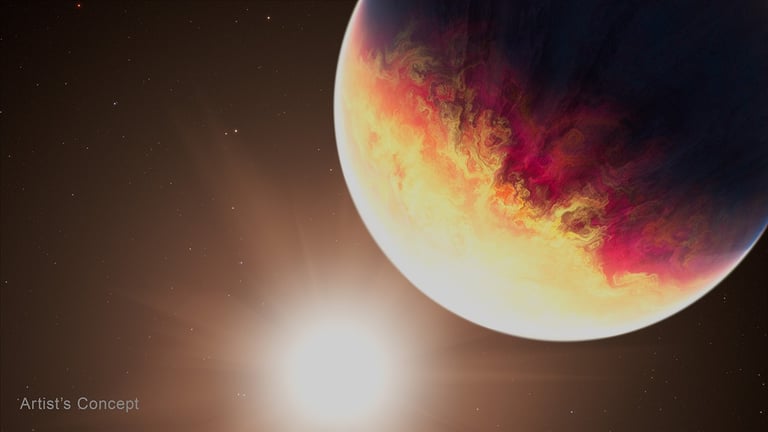


HD 80606 b is a highly eccentric hot Jupiter roughly four times the size of Jupiter, orbiting its Sun-like star every 111 days and undergoing extreme temperature swings that spike to about 1,100 degrees Fahrenheit near periastron.
The planet has earned the nickname the roasted exoplanet for its dramatic heating near closest approach, a label rooted in prior Spitzer data and refined by JWST observations of atmospheric chemistry.
Researchers stress that the dataset is rich and growing, with expectations for new insights into hot Jupiter atmospheres and exoplanetary science as analysis continues.
The discovery and measurements were presented at the 248th meeting of the American Astronomical Society, with collaboration among NASA's JPL and the Cornell Center for Astrophysics and Planetary Science.
Webb’s infrared observations, following Spitzer’s legacy, are advancing the understanding of exoplanet atmospheres and the thermal processes that shape them.
Webb’s spectroscopy has identified and tracked chemical signatures such as methane and carbon dioxide in HD 80606 b’s atmosphere, enabling deeper atmospheric analysis under changing conditions.
The JWST data are designed to distinguish these chemical signals and apply the findings to other hot Jupiters and exoplanets, expanding knowledge of atmospheric chemistry.
The study highlights that the planet’s unusual orbit allows rapid observation of temperature and chemical changes within hours, informing broader understanding of exoplanetary atmospheres.
Dr. Laura C. Mayorga of Johns Hopkins Applied Physics Laboratory notes that observing HD 80606 b under its varying conditions enables rapid data collection relevant to wider exoplanet studies.
JWST/MIRI observations captured a temperature increase of about 1,100 degrees Fahrenheit as the planet approached periastron, providing real-time data on atmospheric response and cloud dynamics.
Observations were planned over several years due to the planet’s 111-day orbit and JWST’s field-of-regard constraints, including a secondary eclipse when the planet passes behind its star.
The Webb collaboration includes researchers from JPL, Johns Hopkins APL, and the Cornell Center, with international partners from ESA and CSA.
Summary based on 3 sources
Get a daily email with more Tech stories
Sources
NASA Science • Jun 16, 2026
NASA's Webb Catches Exoplanet Getting Roasted - NASA Science
CNET • Jun 17, 2026
NASA's James Webb Space Telescope Watched a Planet Get Absolutely Scorched
Talker • Jun 17, 2026
Scientists show how a planet gets roasted by extreme heat