Kazakhstan-EU Partnership Expands: Focus on Technology, Connectivity, and Industrial Growth Beyond Energy
June 22, 2026

Visa cooperation and easier travel are highlighted as tangible benefits for students, researchers, entrepreneurs, and families on both sides.
A 2025–2026 roadmap guides cooperation on sustainable raw materials, batteries, renewable hydrogen, exploration, processing, recycling, research, and skills, with progress tied to clear commercial plans, transport links, and predictable regulation.
The talks aim to strengthen resilience, expand connectivity, and create new opportunities for citizens by linking energy and food security with critical raw materials, the Middle Corridor, AI, travel facilitation, education, and research.
The Kazakh president visited Brussels to push an expanded EU–Kazakhstan partnership beyond energy and raw materials toward technology, connectivity, and industrial development.
Ukraine-related issues, sanctions, and human rights remain integral, with commitments to freedom of expression, independent media, and protection of human rights defenders forming a political dimension alongside commercial cooperation.
There is progress on easing travel restrictions with the EU, and efforts are being made to deepen education and science cooperation through student exchanges, framed by reforms for accountability, transparent governance, and a stable investment climate.
Visa facilitation negotiations have advanced, aiming to simplify procedures and enable easier travel for Kazakh citizens, though full visa-free travel is not yet on the table.
Reforms and people-centered partnership are emphasized through visa progress for students, researchers, and entrepreneurs, with participation in Erasmus+ and Horizon Europe and a constitution focused on law, order, human rights, and stronger institutional accountability.
Education, science, and innovation are to be elevated via deeper participation in Erasmus+ and Horizon Europe, expanding academic mobility and joint innovation opportunities.
Governance and reform link external partnerships to Kazakhstan’s internal modernization, offering stable, predictable, and transparent conditions for European investors.
Central to the talks is the Middle Corridor, a Europe–Asia connectivity backbone that aligns with the EU Global Gateway and will support Europe’s markets alongside Kazakhstan’s resources and logistics capabilities.
Kazakhstan’s economy grew by about 6.5% in 2025 to roughly $306 billion, with IMF projections pointing to over $360 billion in 2026, underscoring Kazakhstan’s growing role as a dependable Eurasian partner for Europe.
Summary based on 7 sources
Get a daily email with more EU News stories
Sources
euronews • Jun 22, 2026
Kazakhstan's president in Brussels: Focus on energy, transportation routes, AI, and more
euronews • Jun 22, 2026
Kazakhstan and the European Union: Building the next chapter of a strategic partnership
The Times Of Central Asia • Jun 22, 2026
Tokayev Heads to Brussels as Kazakhstan and EU Seek Progress on Trade, Minerals and Transport - The Times Of Central Asia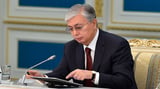
anewz.tv • Jun 22, 2026
Tokayev seeks deeper EU partnership beyond energy