Mars Rover Finds Strongest Organic Signal Yet, Hinting at Possible Ancient Life
June 24, 2026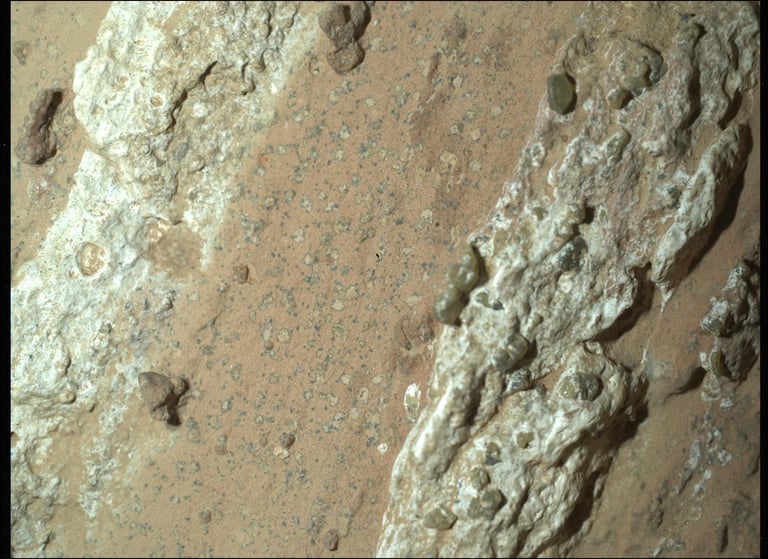

Previously observed leopard spots or poppy-seed patterns had hinted at ancient microbial activity, though non-biological explanations remain possible.
The Perseverance rover’s SHERLOC instrument detected macromolecular carbon in Bright Angel mudstones along Neretva Vallis, hinting at potential signatures of ancient microbial life on Mars but stopping short of proof since MMC can form via abiotic as well as biological processes.
SHERLOC spectroscopy mapped organic matter within the mudstones, revealing hundreds of detections and representing the strongest organic signal found in Jezero crater to date.
Jezero crater’s history of water makes the widespread carbon signals in Bright Angel mudstones surprising and encouraging for future biosignature detection.
The MMC may be recently exposed or protected by photoprotective minerals, suggesting possible recent exposure or preservation, though its origin remains uncertain.
Possible MMC origins include delivery by interplanetary dust or meteorites or in situ abiotic formation via volcanic, electrochemical, or hydrothermal processes; biological synthesis cannot be ruled out but is not confirmed.
Interpretations of the carbon’s origin remain open, with meteoritic/cosmic dust delivery, abiotic chemistry, or biology on the table, requiring further study.
Researchers stress that life on Mars remains unresolved and will hinge on future analysis of cached samples.
The finding represents one of the strongest potential biosignatures to date but does not confirm life, underscoring the importance of Earth-based sample return for conclusive determination.
The results were published in Science Advances on June 24, 2026.
The signal includes leopard spots with minerals vivianite and greigite, suggesting electron-transfer between sediment and organic matter, which is intriguing but not conclusive.
Organic carbon is interwoven with silicate minerals and later-formed carbonates and sulfates, implying two potential emplacement events without revealing the origin.
Summary based on 6 sources
Get a daily email with more Science stories
Sources

The Guardian • Jun 24, 2026
Nasa rover detects potential signatures of ancient microbial life on Mars
New Scientist • Jun 24, 2026
Possible signs of ancient life on Mars are rich in complex carbon
ScienceAlert • Jun 24, 2026
Perseverance Finds Complex Organic Compounds in Strange Mars Rocks