Indigenous-Led Fire Management Combines Tradition and Science to Protect Brazil's Cerrado During Droughts
June 7, 2026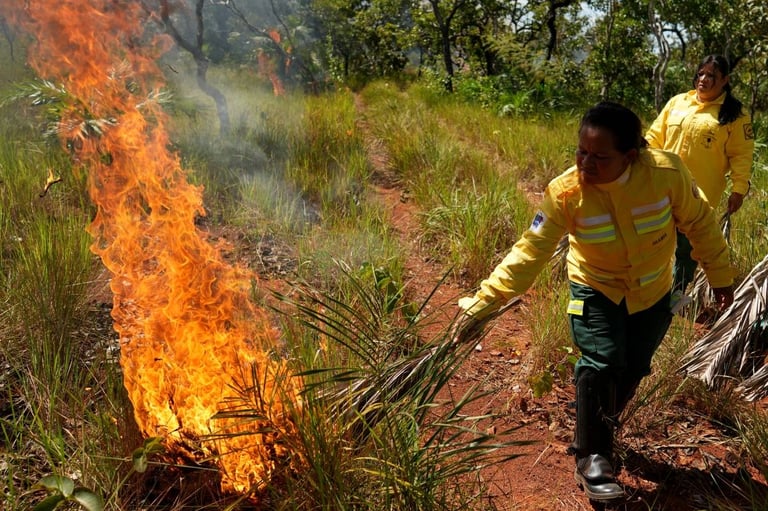


Fire is recognized as a natural and useful part of the Cerrado, with a zero-fire rule outdated; controlled burns guided by Indigenous knowledge and science help reduce fuel buildup and lower high-intensity wildfire risk.
The program funds training and equipment for up to 40 Indigenous brigades across five states, expanding fire prevention responsibilities to Indigenous communities with support from the Bunge Foundation and IBAMA.
Experts stress that, when applied with expertise, fire aids conservation and land management, combining Indigenous knowledge with science as a two-wing approach to environmental stewardship.
Controlled burns are planned using satellite data and local ecological knowledge to create firebreaks that protect villages, headwaters, and sensitive sites during the August–September drought period.
The operation begins with joint planning using satellite data and traditional knowledge to map burns, employing Xerente workers in two-year terms and volunteers, illustrating a community-led, supervised model.
The project embodies knowledge exchange, weaving Indigenous elders’ insights with government strategies, described as two wings of a bird needed for navigation and disaster prevention.
The burn program blends traditional methods (drip torches, dry palm leaves) with government aerial incendiary spheres, enabling quick intervention and creating a patchwork of burned areas to protect communities and ecosystems.
A coordinated approach combines Indigenous fire practices with scientific oversight to deliver controlled burns and targeted helicopter incendiary drops that form protective barriers around villages and critical sites.
Burn operations are conducted as a coordinated day of activity between officials and Indigenous brigades, featuring ceremonial and cultural elements that emphasize mutual respect and collaboration.
Xerente communities in Tocantins coordinate with IBAMA to conduct planned, controlled burns during the pre-dry-season period to prevent larger wildfires and mitigate El Niño impacts.
El Niño–related droughts heighten fire risk in Brazil, underscoring the need for coordinated fire management across government and Indigenous groups.
Anticipated El Niño conditions are expected to worsen droughts, making integrated fire management essential for Cerrado and Amazon regions.
Summary based on 3 sources
Get a daily email with more World News stories
Sources
Yahoo News • Jun 7, 2026
In Brazil’s Cerrado region, Indigenous fire practices reshape wildfire strategy
Yahoo News Canada • Jun 7, 2026
In Brazil’s Cerrado region, Indigenous fire practices reshape wildfire strategy
The Manila Times • Jun 7, 2026
In Brazil’s Cerrado region, Indigenous fire practices reshape wildfire strategy