Boost System Resilience: Master Failures with Six Core Tools & Node.js Techniques
July 13, 2026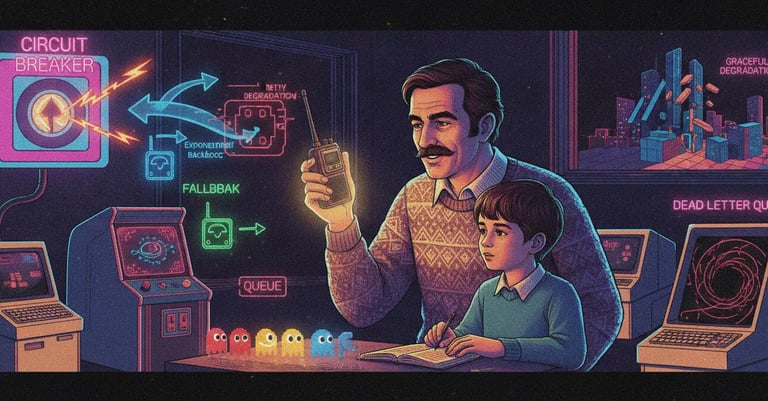

Introduction: A systems-resilience guide outlines how to rapidly detect failures and close the gap between failure and awareness using six core tools.
Support for asynchronous work: Decouple non-critical tasks (like emails) from user requests using a queue, with BullMQ and Redis as practical examples.
Fallback principle: When in doubt, provide an alternative response instead of retrying, prioritizing user experience over perfect accuracy.
Circuit breakers on the horizon: Previewing a circuit breaker approach that halts efforts toward a failing downstream service and introduces cooldown behavior.
Concrete implementations: Practical Node.js examples show how to implement timeouts, health checks, heartbeats, structured logging, metrics, and meaningful error responses.
Code-level guidance: Examples cover Retry, Exponential Backoff with jitter, Fallback, Queue, and Dead Letter Queue to apply concepts in real projects.
Health checks clarified: Distinguish between a process being alive and the entire system being healthy, with Kubernetes routing around unhealthy instances via health endpoints.
Graceful degradation: Frame resilience as preserving core functionality while gracefully degrading non-critical features during failures.
Logging best practices: Emphasize structured logging for efficient querying and faster root-cause analysis.
Heartbeats matter: Use scheduled signals from background workers to detect failures in non-HTTP components and catch silent deaths.
Timeouts for speed: Introduce timeouts to detect unresponsive calls quickly, preventing hangs and enabling immediate error handling.
Retry safety: Emphasize idempotence and caution against retrying money/state-changing operations; retries should be limited to safe operations.
Summary based on 2 sources
Get a daily email with more Tech stories
Sources

DEV Community • Jul 12, 2026
Failure Engineering Explained by Uncle to Nephew — Episode 3: Failure Detection
DEV Community • Jul 13, 2026
Failure Engineering Explained by Uncle to Nephew — Episode 4: Failure Handling