FINICI Unveils Hidden Enzyme Activity, Revolutionizing Drug Targeting Through Spatial Cell Imaging
July 15, 2026

Using FINICI, the researchers observed bursts of Src kinase activity in small membrane regions, including cholesterol-rich lipid rafts, revealing spatially distinct signaling patterns not captured in whole-cell measurements.
FINICI lets researchers reuse existing negative biosensors without redesign, enhancing real-time observation of where biochemical events happen inside cells.
The overall findings show that where a molecule acts inside the cell is crucial for signaling outcomes and drug efficacy, with location-dependent enzyme activity shaping how targets influence pathways and therapeutic targeting.
Therapeutic targeting may hinge on the spatial residency of targets and their partners inside cells, underscoring the importance of subcellular localization in drug development.
FINICI, short for Fluctuation Increase Negated by Intra-Chain, enables visualization of previously hidden enzyme activities with high spatial resolution across small regions of whole cells.
The technique maps live-cell enzyme activity by turning negative readouts into positive signals, allowing existing biosensors to be used without redesign.
The study’s findings were published in the Proceedings of the National Academy of Sciences, highlighting the credibility and reach of the work.
The method imaged Src kinase, Syk kinase, and cGMP, uncovering localized activity: transient and persistent Src activity at the membrane, clustered and fast-disappearing cGMP signals, and Syk peaking near internal scaffolding.
Src kinase activity appeared in lipid rafts and multiple brief microdomains, while cGMP formed small clusters that quickly get overwhelmed as signaling spreads; Syk activity concentrated near intracellular scaffolding rather than receptors.
Spatial localization of signaling events can influence drug efficacy, offering important implications for understanding drug behavior and improving targeted therapies.
University of Illinois Chicago researchers unveiled FINICI, a new imaging method that converts negative biosensor signals into positive ones to visualize enzyme activity across the entire cell.
FINICI addresses prior issues of dim, inverted signals by making previously hidden reactions visible, enabling clearer mapping of where cellular signaling occurs.
Summary based on 4 sources
Get a daily email with more Science stories
Sources

UIC today • Jul 14, 2026
New cell imaging method shines a light on blind spots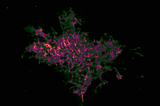
Newswise • Jul 14, 2026
New Cell Imaging Method Shines a Light on Blind Spots | Newswise
BIOENGINEER.ORG • Jul 15, 2026
New Cell Imaging Technique Illuminates Previously Hidden Cellular Blind
News-Medical • Jul 14, 2026
New imaging method reveals hidden molecular interactions in cells