Milky Way's Dramatic Past: 90-Degree Flip Linked to Ancient Galactic Collision
July 21, 2026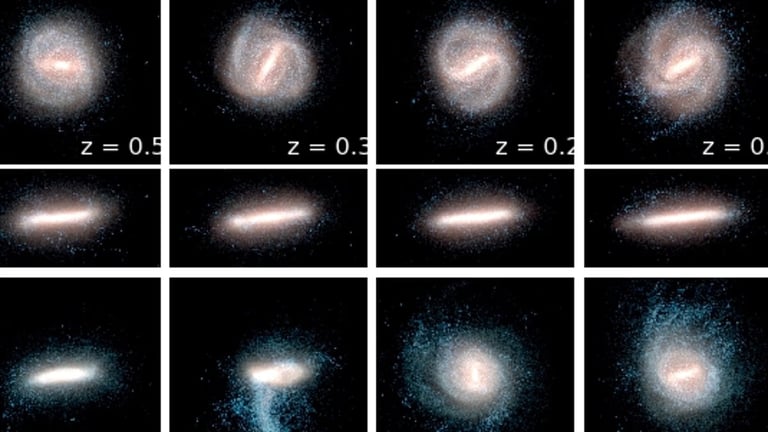


A new study argues the Milky Way’s stellar disc underwent a dramatic flip of more than 90 degrees in the distant past, likely triggered by a head-on collision with the Gaia–Sausage–Enceladus dwarf galaxy some 10 to 11 billion years ago.
The collision and the resulting disc reorientation help explain why the Milky Way’s halo stars rotate slowly (around 25 km/s) compared with the disc’s fast rotation (about 220 km/s.
Simulations of 25 Milky Way–like galaxies show the halo’s slow rotation is correlated with both the ancient collision and the major disc flip, suggesting the Galaxy’s history is far more tumultuous than its current calm appearance.
The new findings are being presented at the Royal Astronomical Society’s National Astronomy Meeting in Birmingham.
The report also notes the discovery of the extremely old star J0815+4729, formed shortly after the Big Bang, highlighting parallel efforts to understand the Galaxy’s early history.
Future mergers include the Large Magellanic Cloud, expected to have a comparatively milder impact, and the Sagittarius dwarf galaxy, which is presently interacting but far less massive than Gaia Sausage.
The link between the Milky Way’s halo rotation and its dark matter halo is highlighted, indicating that understanding the halo’s origin could inform broader questions about dark matter and galaxy formation.
The Gaia–Sausage–Enceladus event is tied to scattering billions of stars into sausage-shaped orbits and is implicated as the trigger for the disc flip, fitting into a larger story of the Milky Way’s growth through mergers.
Gaia–Sausage is identified as the Milky Way’s last major merger, a defining event that formed the central bulge and shaped the halo; the involved dwarf contained more than 10 billion solar masses across stars, gas, and dark matter.
This collision was first revealed in 2018 through Gaia data, which showed sausage-like stellar orbits linked to the Gaia–Sausage dwarf galaxy as it merged with the Milky Way.
Overall, the study emphasizes that the Milky Way’s current structure reflects a violent past, and that disc flips and slow halo rotation should be incorporated into models of galactic evolution and interpretation of observations.
Summary based on 2 sources
Get a daily email with more World News stories
Sources

The Guardian • Jul 21, 2026
Milky Way flipped in collision with dwarf galaxy 10bn years ago, astronomers say
Daily Mail • Jul 21, 2026
Cosmic gymnastics: Study reveals how our Milky Way once underwent a dramatic FLIP