Neural Circuits Key to Habit Formation and Execution: New Insights for OCD and Addiction Therapy
July 27, 2026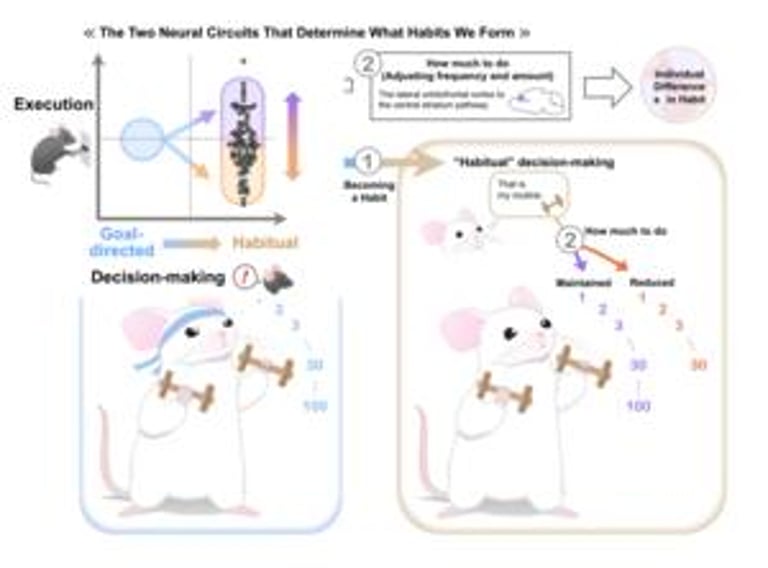

Researchers demonstrated causal roles by bidirectionally manipulating these pathways; stimulating or inhibiting them could induce habit formation or adjust the magnitude of habitual execution on demand.
Two distinct neural circuits govern habit formation and execution: the anterior cingulate cortex to retrosplenial cortex circuit determines whether a behavior becomes a habit, with its connections weakening during the transition, while the lateral orbitofrontal cortex to central striatum circuit controls how strongly the habit is carried out.
The study appears in open-access Nature Communications, with affiliations including Kyoto University and a collaboration among neuroscience-focused teams.
The findings imply potential applications for cultivating beneficial habits while mitigating problematic ones, such as those linked to obsessive-compulsive disorder.
Researchers aim to understand why individuals differ in habit strength to better promote beneficial habits and reduce compulsive patterns.
Manipulating the two circuits reveals their dissociable roles in decision-making strategy and habit execution, allowing selective promotion of habit formation or tuning execution levels.
The paper, titled “Dissociable roles of prefrontal plasticity in decision making strategy and execution of habitual behavior,” was published in Nature Communications on July 27, 2026 (doi: 10.1038/s41467-026-75706-1).
The work contributes to a 2026 Nature Communications publication that delineates how prefrontal plasticity supports distinct aspects of habit formation and execution.
The results challenge the view that repetition merely replicates actions, showing substantial individual differences in habit frequency and intensity even after habits are established.
Habit formation is more complex than repetition alone, with notable variation in how often and how intensely people perform habitual actions.
Findings point to targeted therapies that down-regulate hyperactive habit execution (lOFC to central striatum) without harming goal-directed learning, offering potential avenues for OCD and addiction treatments.
Overall, habit formation emerges as a dual process involving separate changes in decision-making strategy and execution level, rather than a simple replication of past actions.
Summary based on 3 sources
Get a daily email with more Science stories
Sources
Medical Xpress • Jul 27, 2026
Two neural pathways reveal why habits form and vary in intensity
Neuroscience News • Jul 27, 2026
Dual Brain Circuits Drive Habit Formation
EurekAlert! • Jul 27, 2026
Unraveling the mysteries of habit formation