New AI Framework Enhances Scientific Inference Using Simulation-Grounded Neural Networks
August 12, 2026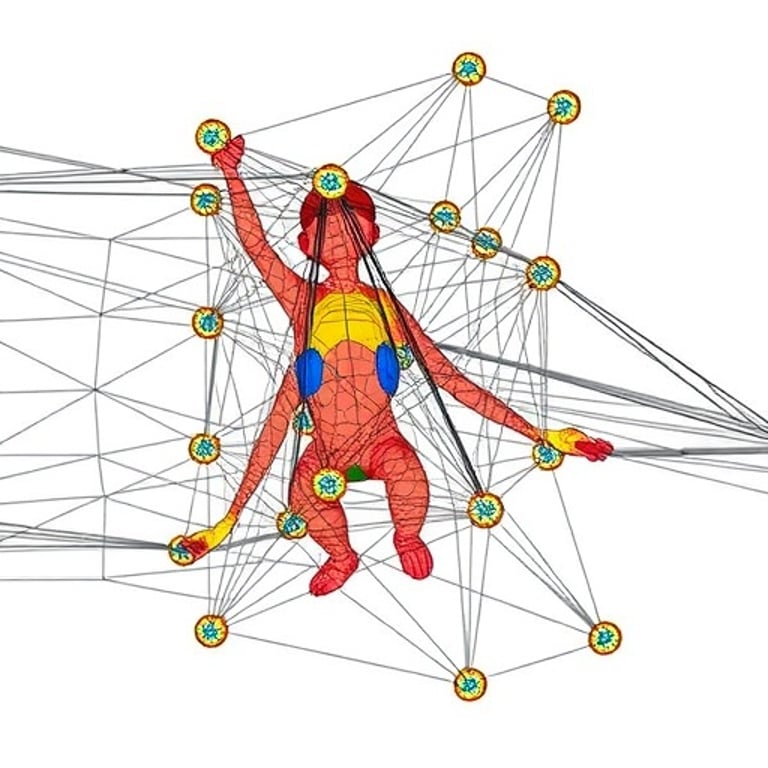


A new framework, Simulation-Grounded Neural Networks (SGNNs), trains neural networks on mechanistic simulations to enhance scientific inference across disciplines.
By integrating physics-based modeling with machine learning, SGNNs estimate hidden parameters, test explanations, and make predictions even with incomplete measurements.
Funding comes from the Insight Net cooperative agreement with the University of Michigan via the CDC’s Center for Forecasting and Outbreak Analytics, with authors noting the content reflects their views, not official CDC positions.
The work presents AI as a partner to scientific computing, not a replacement for experiments, emphasizing model testing, uncertainty quantification, and maintaining validity under real-world observations.
A careful training regime addresses the simulation-to-real gap by incorporating realistic noise, comparing multiple mechanistic models, recalibrating simulations with experimental data, and quantifying uncertainty in outputs.
Hybrid systems—mechanistic simulations for structure, neural networks for speed, and real experiments for validation—are likely the most trustworthy path toward reproducible discovery.
Mechanistic simulations provide explicit system descriptions and generate large labeled synthetic datasets to guide networks toward causally meaningful mappings rather than spurious correlations.
In forecasting tasks, SGNNs outperform standard data-driven baselines and physics-constrained hybrids, delivering substantially higher forecasting skill in COVID-19 mortality forecasts and accurate high-dimensional ecological predictions.
The inverse problem is hard due to noise and non-identifiability, but mechanistic training constrains networks by the system’s structure to reduce reliance on accidental data features.
SGNNs train on diverse synthetic data across multiple model structures with realistic observational noise, internalizing system dynamics as a structural prior for robust learning even when equations are partially unknown.
They demonstrate robustness to model misspecification, performing well even when trained on data from incorrect assumptions.
The framework introduces back-to-simulation attribution, a mechanistic interpretability method that links real-world dynamics to the most similar simulated counterparts in the training corpus.
Summary based on 2 sources
Get a daily email with more AI stories
Sources

Nature • Aug 12, 2026
Training neural networks on mechanistic simulations improves scientific inference
BIOENGINEER.ORG • Aug 12, 2026
Mechanistic Simulation-Trained Neural Networks Improve Scientific Inference