Vision, Not Frontal Lobes, Drove Primate Brain Evolution, Duke Study Reveals
August 12, 2026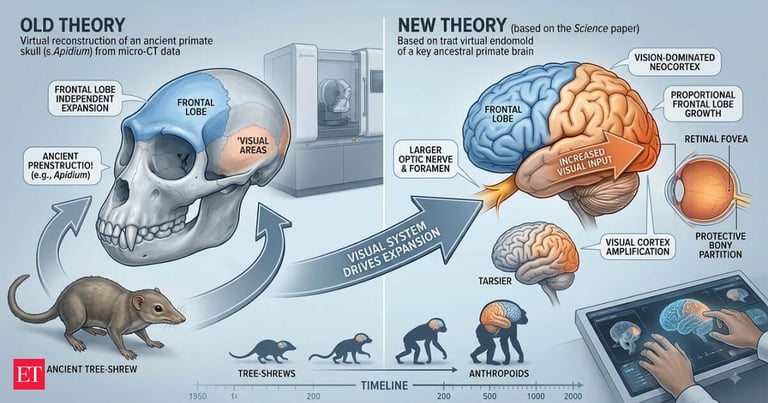

A new study argues primate brain enlargement mostly reflects expansion of visual processing regions (occipital, parietal, temporal) rather than a repeated frontal-lobe surge tied to higher reasoning.
Researchers modeled brain evolution using virtual endocasts from skulls at the Duke Lemur Center Museum, generated through high-resolution micro-CT scanning to compare living and extinct primates.
The narrative integrates fossil data, digital imaging, and scaling analysis to suggest that increased visual input spurred neural tissue growth, reshaping the trajectory of primate brain evolution.
Limitations include the indirect nature of endocasts for mapping brain wiring and using the optic foramen as a proxy for visual input, leaving some neural details unresolved.
Context and limitations: fossil endocasts inform brain organization but do not claim a single definitive cause, instead offering a perspective that vision influenced neocortex expansion.
The authors argue that quantitative viewing of fossils via endocasts yields a clearer picture of brain evolution than purely shape-based interpretations.
Two discussed drivers emerge: greater social complexity and improved foraging efficiency, both potentially increasing visual demands and shaping brain growth.
The visual-driven expansion may relate to social complexity or foraging efficiency as selective pressures guiding primate brain evolution.
Visual processing growth is proposed to reflect selective pressures from vision-related demands rather than a sole emphasis on frontal executive functions.
Lead author Richard F. Kay notes that enlarged brains are more tightly linked to vision than to the frontal lobe's relative expansion.
Findings suggest large-brained anthropoids arose at least 33 million years ago, with high-acuity vision underpinning neural evolution rather than a disproportionately large frontal cortex.
Implications for human evolution: the trajectory of the human brain may be closely tied to the evolution of high-definition vision and related anatomical adaptations dating back tens of millions of years.
Summary based on 8 sources
Get a daily email with more Science stories
Sources
Economic Times • Aug 12, 2026
Scientists rebuilt ancient primate brains from fossils and found a stunning clue to human evolution: The b
Economic Times • Aug 12, 2026
Scientists rebuilt ancient primate brains from fossils and found a stunning clue to human evolution: The b