Supreme Court Asked to Review Texas Law Mandating Ten Commandments in Schools
August 18, 2026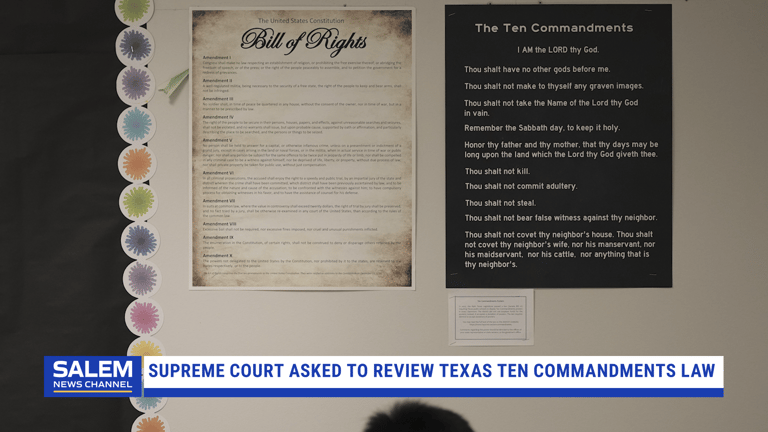

Civil rights advocates petition the Supreme Court to review Texas’ law that requires public schools to display the Ten Commandments, signaling a potential new test of state-sponsored religious expression in classrooms.
The 5th Circuit upheld the law in a narrow 9-8 decision, allowing implementation amid challenges from families and civil rights groups represented by the ACLU and others.
Governor Abbott signed the law, which took effect last fall; districts may display the posters only with donations, leading to a wave of poster donations across the state.
The authors present a new paper blending law, history, and theology, produced at Emory University, focusing on Establishment Clause jurisprudence and government prescription of religious doctrine.
Washington’s and the Supreme Court building’s biblical displays are cited as examples of long-standing integration of religion in government spaces, framing removal as inconsistent with constitutional values.
Kelly Shackelford of First Liberty Institute is portrayed as arguing that religious heritage is an integral part of American history and law, and that the display is a modest, constitutionally sound acknowledgment of that heritage.
The paper’s first major contribution argues the Establishment Clause prohibits the government from prescribing particular religious doctrines, offering a nuanced view between endorsement and coercion and drawing on the English established church’s practice of posting commandments.
It argues that posting the Ten Commandments does not amount to government coercion or establishment because it involves exposure to historical and moral content rather than forced belief or participation.
The article notes ongoing political and legal contention around religion in public schools and references broader debates and related cases without detailing any ruling beyond the appellate stage.
The piece emphasizes that public education naturally exposes students to a range of religious and philosophical ideas, and that the Constitution protects against government coercion rather than preventing exposure to religion.
Kennedy v. Bremerton School District is cited as shifting Establishment Clause analysis toward evaluating historical practices and understandings of religion in public life rather than applying the Lemon test.
The article provides a downloadable link to an SSRN paper and references related scholars and works for context.
Summary based on 8 sources
Get a daily email with more US News stories
Sources
Education Week • Aug 18, 2026
Supreme Court Asked to Review Law Requiring Ten Commandments in Public Schools
Salem News Channel
Supreme Court Asked To Review Texas Ten Commandments Law
Houston Public Media • Aug 18, 2026
Supreme Court asked to review Texas law requiring the Ten Commandments in public schools