Phage T7 Kinase Disables Bacterial Defenses by Phosphorylating Key Proteins
August 19, 2026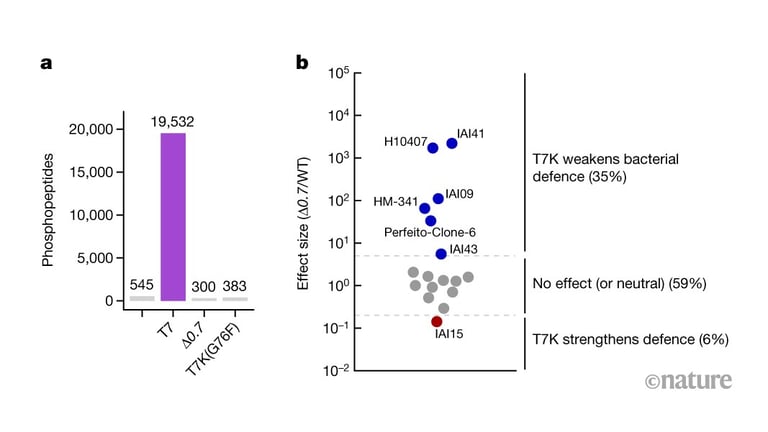

A phage-encoded kinase, T7K, can disable bacterial defense systems that target nucleic acids by phosphorylating key proteins, as shown with Retron-Eco9 and the DarTG1 toxin–antitoxin system, where phosphomimetic changes abolish defense activity.
T7K specifically targets DNA-binding proteins, enabling it to undermine nucleic-acid–targeting defenses across multiple systems.
Identified phosphosites on Retron-Eco9’s RcaT and on DarT within DarTG1 show that phosphomimetic substitutions compromise defense, indicating phosphorylation reduces toxin activity or stability and neutralizes anti-phage responses.
The article includes licensing details (CC BY 4.0) for expert opinion and figures and provides a DOI to the Nature paper.
The discovery is framed within the broader context of bacteriophage–bacteria interactions and immune evasion strategies.
Phosphoproteomics revealed extensive remodeling of both host and phage proteins during infection, detecting over 15,000 phosphopeptides with most dependent on an active T7K.
T7K shows a broad substrate range, phosphorylating serine, threonine, and tyrosine without strict sequence preference, with a bias toward nucleic-acid-binding proteins due to a DNA-binding C-terminal domain.
This finding is presented as a research brief summarizing Bartolec et al., Pervasive phosphorylation by phage T7 kinase disarms bacterial defences, Nature 2026.
T7K phosphorylates numerous host proteins at high stoichiometry, including transcriptional regulator RcsB, linking to silencing of host defenses and aiding phage replication.
Deletion of the SO domain reduces overall phosphorylation by about 31% and shifts the phosphorylation landscape, suggesting the SO domain both targets substrates and sustains kinase activity.
phosphorylation follows a rapid wave within the first five minutes of infection, peaking before autoinhibition, shaping early host–phage interaction dynamics.
A viral kinase named T7K phosphorylates nearly all bacterial proteins, enabling broad countermeasures against defense systems.
Summary based on 2 sources
Get a daily email with more Science stories
Sources
Nature • Aug 19, 2026
Pervasive phosphorylation by phage T7 kinase disarms bacterial defences
Nature • Aug 19, 2026
Virus deploys a ‘loose cannon’ enzyme to overpower bacterial defences