Elephant Skin-Inspired Tiles Offer Passive Cooling Solution for Buildings Without Electricity
August 20, 2026

A biomimetic tile system cools buildings by capturing and spreading water across the surface, enabling slow evaporation that pulls heat away, inspired by the network of cracks in elephant skin.
Tiles are cement-based, made from ordinary Portland cement mixed with diatomaceous earth, cast into thin forms, and partially hydrated to create a predictable crack lattice that guides water movement.
A Penn-led team, including Dorit Aviv with Shu Yang and Kun-Hao Yu, developed these cement-based tiles that passively cool buildings through evaporation for up to 20 hours without fans, compressors, or electricity.
Prototype panels can be produced over large areas with hopper guns, pointing toward feasible on-site fabrication, with future work on automated watering cycles tied to real-time weather data.
There is clear potential for large-panel applications, using hopper guns for scale, and automated water delivery guided by forecasts to optimize cooling.
Research team affiliations include Dorit Aviv (Weitzman School of Design, Penn), Shu Yang (Penn Engineering), Kum-Hao Yu (Syracuse University), with contributions from Yunchan Lee, Ji Yoon Bae, and Qingya Huang; funding from DOE ARPA-E HESTIA and NSF.
Beyond the study, Yang’s venture Minerava aims to commercialize carbon-capturing, passively cooled concrete, with the Advanced Materials publication highlighting the work.
The cooling effect can lower surface temperatures by roughly 10–20°F (about 6–11°C) compared with traditional stucco, offering a passive method that could reduce reliance on conventional AC.
Under infrared heating tests, the tiled surface stayed at 89.6°F, while cracked stucco reached 107.6°F and non-cracked stucco 125.6°F, illustrating significant cooling advantages.
Future directions include integrating tiles with smart building controls and weather data to trigger watering cycles for optimized water use and cooling.
Microscopic pores rapidly absorb water, and the hexagonal crack pattern sustains cooling for up to 20 hours; infrared tests showed surface temperatures around 32°C with periodic watering, versus 42°C for cracked stucco and 52°C for non-cracked stucco.
The system’s key design features are a hexagonal crack lattice guiding water, micro-pores acting as reservoirs, and a pattern that promotes lateral water flow for sustained cooling.
Summary based on 3 sources
Get a daily email with more Science stories
Sources

EurekAlert! • Aug 19, 2026
Buildings that cool like African elephants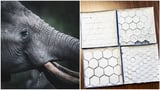
India Today • Aug 20, 2026
Elephant skin, cement and water: Recipe to make buildings stay cool
Earth.com • Aug 20, 2026
Elephant skin inspires a new way to keep buildings cool