China's World Humanoid Robot Games: Record-Breaking Sprints and AI Advances in Beijing
August 25, 2026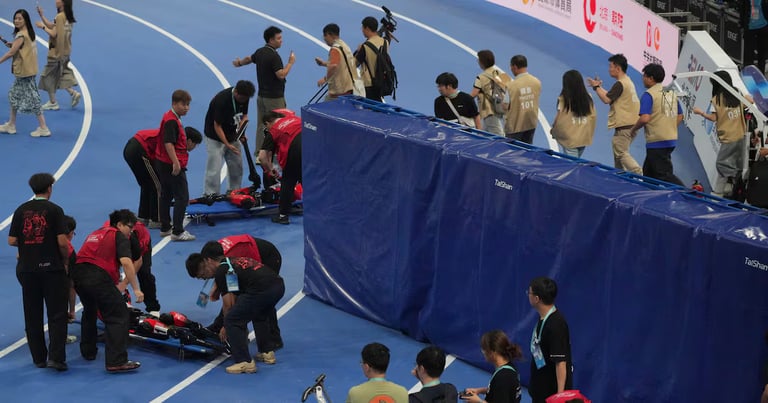

China hosted the World Humanoid Robot Games in Beijing, showcasing rapid robotics progress with more than 2,000 humanoid robots across 51 events and 1,000 competitions.
In the games, robots ran a historic 100-meter sprint, breaking the previous record of 9.39 seconds set just days earlier, and overall demonstrations spanned sprinting, jumping, kung fu, dance, and practical tasks like laundry and delivery.
Beyond athletic events, participants tackled real-world tasks such as household chores, hotel service, and emergency response, illustrating a push toward embodied AI with real-world applications.
Researchers describe a unified, end-to-end policy that combines visual perception, state estimation, bipedal locomotion, and physical interaction, designed to operate under noisy, delayed, and occluded conditions.
Experts note that while whole-body control has improved, current systems remain task-specific and face challenges with safe deceleration, generalization, and reliability across multiple trials.
Analyses indicate autonomous on-board computation is often complemented by cloud AI and 5G connectivity, raising questions about true independence and resilience in real-world use.
The Brazilian team focused on perception, localization, decision-making, motion planning, and execution to operate the T1 humanoid, which features 23 degrees of freedom and onboard sensors including a depth camera and microphones.
Performance results showed a substantial reduction in ball-position error and time-to-kick, with high kicking success rates achieved in frontfield positions, all trained in simulation and deployed on hardware without real-world fine-tuning.
In RoboCup tests, the methods achieved high front-field success rates and meaningful back-field performance without falls, indicating robustness across scenarios within the tested range.
Humanoid soccer demonstrates embodied intelligence, requiring integrated software and hardware to interpret environments, balance, coordinate joints, and execute timed kicks.
However, the control framework currently does not support team play, as it does not account for teammates or opponents, limiting passes and coordinated strategies.
A Science Robotics paper from Tsinghua University and partners presents a vision-driven, end-to-end reinforcement learning framework for real-world soccer tasks on onboard platforms, highlighting end-to-end perception-action coupling and an encoder-decoder system to handle occlusions.
Summary based on 17 sources
Get a daily email with more Tech stories
Sources
Yahoo! Finance • Aug 21, 2026
Booster Robotics Powers Science Robotics Research Article on Vision-Driven Humanoid Soccer Skills
Ars Technica • Aug 25, 2026
World humanoid robot games show runners breaking records, bursting into flames
AP News • Aug 25, 2026
Chinese humanoid robot Beijing World Humanoid Robot Games robotics | AP News
Interesting Engineering • Aug 25, 2026
Brazilian coders power Chinese humanoid robots in high-tech soccer showdown in Beijing