Study Unveils Kelvin–Helmholtz Waves as Key to Mars' Atmospheric Ion Escape
August 3, 2026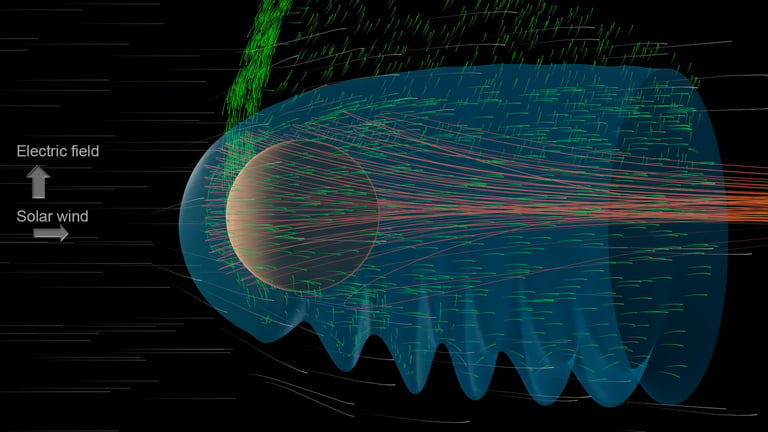

A Boston University-led study in Science Advances identifies Kelvin–Helmholtz waves, driven by solar wind boundary instabilities, as a key mechanism behind bulk atmospheric ion escape from Mars.
The research builds on simultaneous MAVEN and Tianwen-1 observations of solar wind changes and points to future work with ESCAPADE and simulations to quantify how these waves contribute to total atmospheric loss.
It reinforces that multi-spacecraft data can reveal links between the solar wind and Mars’ space environment, suggesting Kelvin–Helmholtz waves are a central driver of escape rather than a uniform global effect.
Understanding this escape mechanism sheds light on Mars’ historical habitability and atmospheric evolution, explaining how a once thicker atmosphere transformed into today’s dry, thin state.
Mars loses atmospheric ions to space through solar wind interaction with the upper atmosphere, a process amplified by the planet’s lack of a global magnetic field.
Without a global magnetic field, Mars experiences direct solar wind coupling to its upper atmosphere, facilitating atmospheric loss to space.
The findings have implications for Mars’ past habitability and atmospheric evolution, and may be relevant to other unmagnetized planets and some exoplanets.
Large clouds of plasma form in Mars’ upper atmosphere, with the escaping ion flow localized on one side depending on the solar wind electric field direction.
Kelvin–Helmholtz waves generate these large plasma clouds, contributing to atmospheric loss and showing a non-uniform distribution around Mars.
The study used simultaneous observations from MAVEN and Tianwen-1 to link upstream solar wind conditions with ion escape near Mars, enabling a direct causal connection.
By combining MAVEN and Tianwen-1 data, the research correlates solar wind conditions with atmospheric escape near Mars, strengthening causal inference.
Summary based on 2 sources
Get a daily email with more Science stories
Sources
Phys.org • Aug 1, 2026
Solar wind stirs Mars' upper atmosphere, boosting ion loss to space
ScienceDaily • Aug 3, 2026
Giant waves are sweeping Mars’ atmosphere into space