President Launches Military Spouse Commission to Tackle Family Challenges and Boost Support
August 3, 2026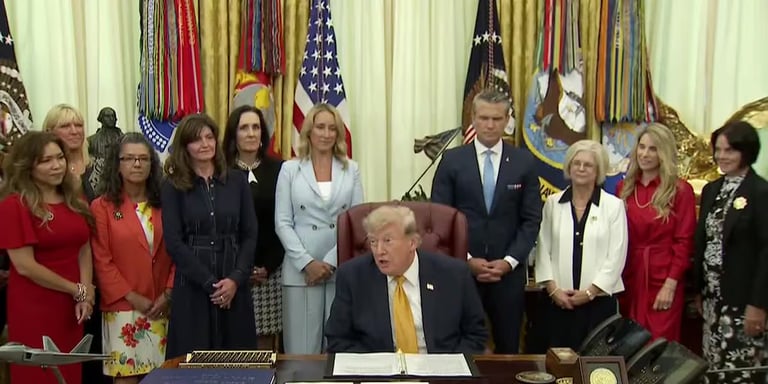

Contextual data cited shows military spouses face unemployment and earning disparities, underscoring the need for job support and career development targeted by the commission.
The commission will operate for two years from signing, unless extended by the president.
The commission will monitor policy implementation, conduct nationwide consultations with military families, and issue annual reports; members will serve unpaid.
The president signed an executive order creating the Military Spouse Commission to identify challenges facing military families and propose policy recommendations aimed at improving their well-being and quality of life.
Jennifer Hegseth will chair the commission, which includes spouses of senior leaders from the Army, Navy, Air Force, and other services, along with the Coast Guard commandant and additional members.
The commission will focus on housing, employment, health care, education, and deployment-related support to strengthen military families and, by extension, readiness.
The broader coverage notes the administration’s ongoing discussions on immigration, border enforcement, and related political issues, alongside remarks about reflecting pool vandalism and a related legal matter.
Federal law already requires annual military pay adjustments, with recent increases averaging roughly 4–5 percent, and the FY2027 defense budget request is noted as the largest ever submitted to Congress.
In related remarks, the president commented on ongoing diplomacy with Iran, saying talks are continuing under regional pressure to pursue denuclearization.
Desiree Sayle was named executive director of the commission, with the group highlighting shared extensive military family experience among members.
The initiative builds on prior moves to broaden spouse employment opportunities, license portability, and remote work options, with surveys indicating top concerns as employment, pay, and housing.
The executive order and commission are presented as a brief, focused report on intended focus areas without additional dates beyond the immediate context.
Summary based on 21 sources