AI Vision Systems Face Real-World Challenges: New Study Explores Traffic Sign Deterioration Impact
August 31, 2026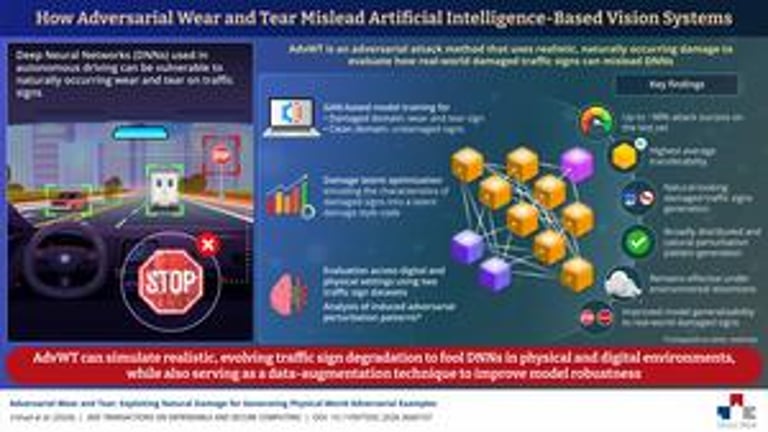


The study shows that training with AdvWT-generated damaged signs improves generalization to real-world deterioration, helping identify and address weaknesses in vision systems.
AdvWT trains a StarGAN-v2–based image-to-image translation model to learn a latent damage style that reproduces realistic deterioration while preserving sign identity, enabling signs to look damaged yet still be misclassified by AI.
The bidirectional model can also restore damaged signs, suggesting potential use in repairing real-world signs and boosting robustness through adversarial training with damaged signs.
The work highlights the need to evaluate natural deterioration’s impact on traffic-sign recognition and to strengthen AI robustness for real-world, high-stakes domains like autonomous driving, healthcare, and finance.
The paper is titled Adversarial Wear and Tear: Exploiting Natural Damage for Generating Physical-World Adversarial Examples, published in IEEE Transactions on Dependable and Secure Computing in May 2026.
The study’s full title is Adversarial Wear and Tear: Exploiting Natural Damage for Generating Physical-World Adversarial Examples, appearing in IEEE Transactions on Dependable and Secure Computing (Volume 23, Issue 3, 2026).
A collaboration between SEOULTECH and Kyung Hee University developed AdvWT, a framework using natural wear and tear on traffic signs as an adversarial signal to test and improve vision-system robustness for autonomous driving.
Led by Associate Professor Seong Tae Kim and Assistant Professor Hong Joo Lee, the team formulated AdvWT to test and enhance AI robustness under real-world sign degradation.
The Kyung Hee University–SEOULTECH effort uses naturally occurring wear on traffic signs to generate adversarial examples for AI vision systems in safety-critical contexts.
Across two traffic-sign datasets and eight recognition architectures, AdvWT achieved near-perfect attack success on lightweight CNNs and remained effective against transformer models, with strong cross-model transferability.
Evaluations showed near-perfect attack success on models like ResNet-18 and MobileNet, with continued effectiveness against transformers across datasets and architectures.
Physical tests involved printing clean and adversarial signs and recapturing them under varying distances, angles, and lighting, with adversarial effects persisting in real-world conditions.
Summary based on 3 sources
Get a daily email with more AI stories
Sources
Tech Xplore • Aug 31, 2026
Worn traffic signs fool AI vision systems, exposing autonomous-driving risks
Cision PR Newswire • Aug 31, 2026
Seoul National University of Science and Technology Develops AI Framework to Test and Improve Vision-System Robustness