HIGEN RNM Launches Revolutionary Actuator Platform for Safer, Responsive Humanoid Robots
August 31, 2026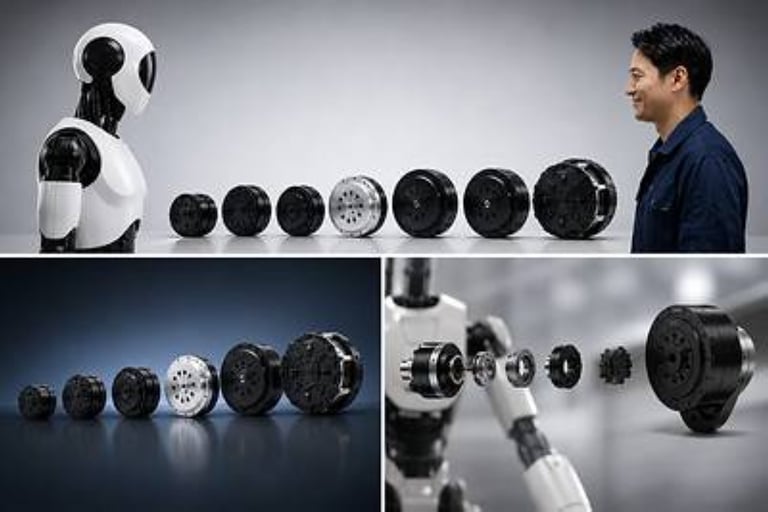

HIGEN RNM unveils the Human-Friendly Actuator Platform, a standardized joint actuator architecture that enables local, under-100-millisecond disturbance adjustments at each joint to make humanoid robots safer, more responsive, and scalable.
The platform translates AI decisions into safe, responsive physical movement for humanoids, emphasizing a distributed control approach where joints autonomously detect disturbances and adjust force and stiffness locally.
Built around an AFPM motor, a 3K compound planetary gearbox, dual encoders, and embedded drive electronics, the design achieves compact size, higher torque density, and the ability to estimate external forces without a dedicated torque sensor.
Technical advantages include localized sensing and control within each joint, a 30% reduction in actuator volume, a 30% boost in torque density, and backdriving torque below 1 Nm to support compliant, safe interactions around people.
The platform emphasizes distributed, autonomous disturbance detection and local adjustment of force and stiffness, reducing dependence on centralized control.
HIGEN RNM has filed three Korean patent applications on sensing and adaptive force-control technologies and has integrated ISO 13849-1 functional safety requirements, pursuing CE and UL certifications.
The company plans to showcase platform performance data and demonstrations at CES 2027 in Las Vegas.
Six standardized actuator designs cover joints from wrists and neck to knees and hips, integrating motors, gear systems, sensing, and drive electronics into a reusable architecture for scalable humanoid robotics.
These six platforms support torque ranges from 60 Nm to 348 Nm, enabling scalable production for diverse humanoid applications.
The architecture combines reduced actuator volume with increased torque density and remains backdriving-friendly for safe, compliant interaction.
Dual-encoder data and motor-current sensing enable estimation of external forces without a dedicated torque sensor, improving sensing efficiency and safety.
A key innovation is embedding localized sensing and control within each joint to detect disturbances and adjust force and stiffness in under 100 milliseconds without relying on central processing.
Summary based on 2 sources
Get a daily email with more AI stories
Sources

TNGlobal • Aug 31, 2026
HIGEN RNM Targets Humanoid Robotics' Next Bottleneck: The Actuator - TNGlobal
The Manila Times • Aug 31, 2026
HIGEN RNM Targets Humanoid Robotics' Next Bottleneck: The Actuator