Breakthrough Genetic Module Boosts Salt Tolerance in Sunflowers, Paving Way for Crop Innovation
September 10, 2026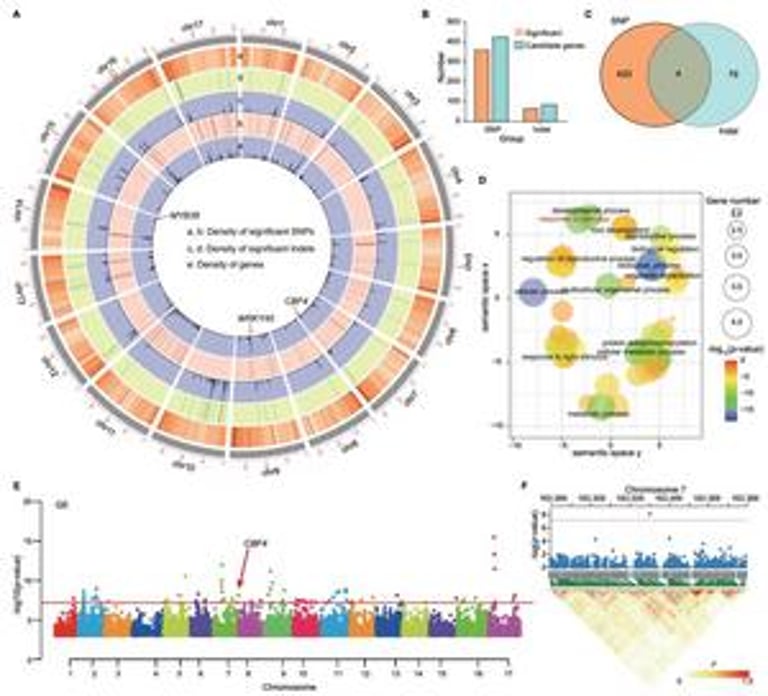

A new study identifies the HaCBF4–HaHAK11 genetic module as a positive regulator of salt tolerance in sunflower during germination and early growth.
The HaCBF4–HaHAK11 module links population-level genetic signals to a concrete molecular mechanism, offering a clearer path from phenotype to gene discovery for breeding salt-tolerant sunflowers.
Silencing HaHAK11 yields salt-sensitive traits and dampens expression of other stress-response genes, indicating HaHAK11 acts as a downstream effector in the pathway.
Future work could test HaHAK11’s contribution to sodium exclusion, potassium balance, or ROS signaling in field conditions and explore marker-assisted selection or gene-editing approaches for salt tolerance.
HaCBF4 directly binds the DRE in the HaHAK11 promoter and activates HaHAK11 expression, as shown by Y1H, luciferase, and EMSA assays.
Functional validation shows HaCBF4 localizes to the nucleus and acts as a positive regulator; silencing HaCBF4 via VIGS leads to reduced water retention, higher ROS and MDA, and greater leaf damage under NaCl exposure.
The study used 342 oilseed sunflower accessions under salt stress, integrating high-throughput phenotyping, whole-genome sequencing, GWAS, transcriptomics, and molecular assays.
GWAS identified 359 trait-associated SNPs and 63 InDels linking to 424 and 83 candidate genes, with HaCBF4 emerging as a strong candidate due to its association with germination energy and salt response.
The work provides practical genetic resources for breeding salt-tolerant sunflowers and outlines a transferable pipeline for other crops using phenomics, WGS, GWAS, and molecular validation.
Summary based on 1 source
Get a daily email with more Science stories
Source
EurekAlert! • Sep 9, 2026
Sunflower’s salt-survival switch comes into focus