CERN's LHC Observes Quantum Entanglement in Higgs-Produced Z Bosons, Advancing High-Energy Physics
September 14, 2026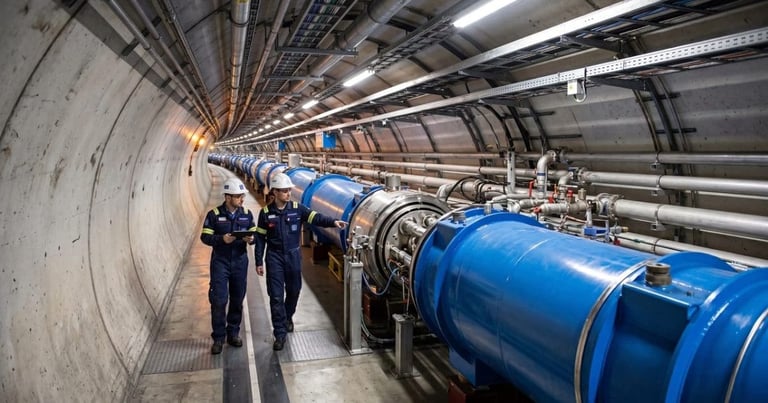

Intro: The ATLAS and CMS collaborations at the LHC report evidence that Z bosons can be quantum entangled, extending entanglement tests to high-energy, massive particles and offering a new probe of Higgs boson interactions.
Context: This advances CERN’s quantum technology initiatives and builds on prior entanglement work with heavy particles, marking progress toward more complex quantum systems at the electroweak scale.
Significance: The finding shows entanglement persists for relatively massive, short-lived particles, broadening the scope beyond earlier collider studies with lighter systems.
Publication timeline: The results appeared in Physical Review Letters in September 2026, highlighting ongoing analysis and the potential for future quantum-information-inspired techniques in high-energy physics.
Statistical strength: The analysis rejects a nonentangled alternative at about 4.7 sigma, indicating strong evidence though not yet reaching a definitive 5-sigma discovery.
Future prospects: Quantum tomography and more data from Run 3 and the High-Luminosity LHC could sharpen sensitivity to possible deviations from the Standard Model.
Quantum interpretation: The study does not imply a breakdown of quantum mechanics; instead, it demonstrates entanglement as a precision tool in high-energy physics.
Methodology: Entanglement was tested via the spin-density matrix and an entanglement-sensitive angular distribution, both aligning with Standard Model predictions within uncertainties.
Institutions and tech: Atlas Technologies provided ultra-high vacuum chambers and bimetal components essential for controlled environments supporting spin-qubit related technologies, aligning with broader quantum computing and sensing applications.
Broader aim: The work is part of integrating quantum information science into high-energy physics to improve pattern detection and explore potential new phenomena beyond current theories.
Notable contributors: Remarks from Professor Alan Barr and Professor Daniela Bortoletto underscore the interpretive and collaborative significance of observing entanglement in massive particles at high energies.
Collaboration and upgrade context: The finding comes from an international collaboration—including Oxford University, UChicago, and CERN—as part of the ATLAS upgrade and the Quantum Technology Initiative, with data from the LHC.
Summary based on 6 sources
Get a daily email with more Science stories
Sources
Quantum Zeitgeist • Sep 14, 2026
CERN’s Large Hadron Collider Finds ‘spooky Action’ In Particle Collisions
BBC Sky at Night Magazine • Sep 15, 2026
Scientists make 'spooky' discovery with the Large Hadron Collider – and it sounds like something straight out of science fiction