Study Unveils ATP Synthase's Crucial Role in Calcium Homeostasis Beyond Energy Production
September 16, 2026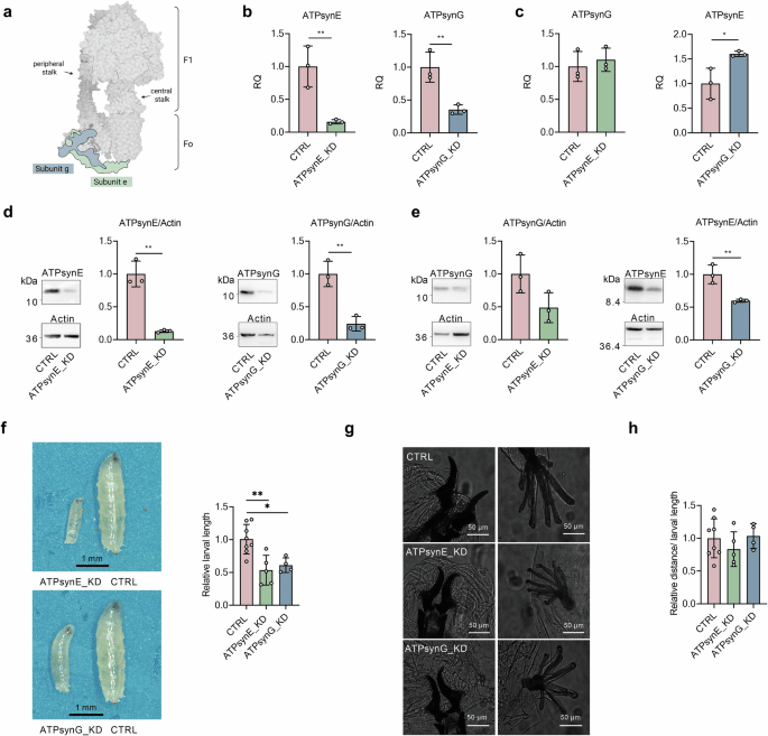

Overall, developmental and neuromuscular defects from downregulation of ATP synthase subunits e and g arise from disrupted Ca2+ signaling via the CICR channel, not from ATP shortage, revealing a noncanonical, evolutionarily conserved role for ATP synthase in Ca2+ homeostasis and development.
Ecdysone biosynthesis is severely impaired in ubiquitous knockdown larvae, with markedly reduced ecdysone and Halloween gene expression, pointing to a Ca2+-dependent regulation of developmental hormonal pathways.
Knockdown reduces mature ATP synthase complexes and alters mitochondrial cristae, leading to decreased respiration and increased glycolytic markers (lactate), while total ATP levels remain largely intact.
Presynaptic NMJ analysis shows structural changes in ATPsynG knockdown larvae, including smaller presynaptic area and reduced NMJ branching, implicating Ca2+ homeostasis in synaptic development and function.
Muscle-specific knockdown yields divergent outcomes: ATPsynG KD supports adult development with locomotor issues, whereas ATPsynE KD causes pupal lethality and severe motor impairment.
In vivo, motor neuron–specific knockdown shows normal basal Ca2+ but slower Ca2+ efflux from the mitochondrial matrix, consistent with reduced CICR channel activity.
Ca2+-retention capacity increases in mitochondria from affected flies, indicating impaired Ca2+-dependent CICR channel activity linked to ATP synthase disruption.
Subunits e and g of ATP synthase are essential for Ca2+ homeostasis and development in Drosophila, independent of ATP production.
Ubiquitous RNAi knockdown of ATPsynE or ATPsynG drastically reduces transcript and protein levels, leading to larval developmental arrest or severe locomotor defects.
Summary based on 1 source