Google Expands Smart Home AI with Model Context Protocol, Enhancing Control and Security Features
September 16, 2026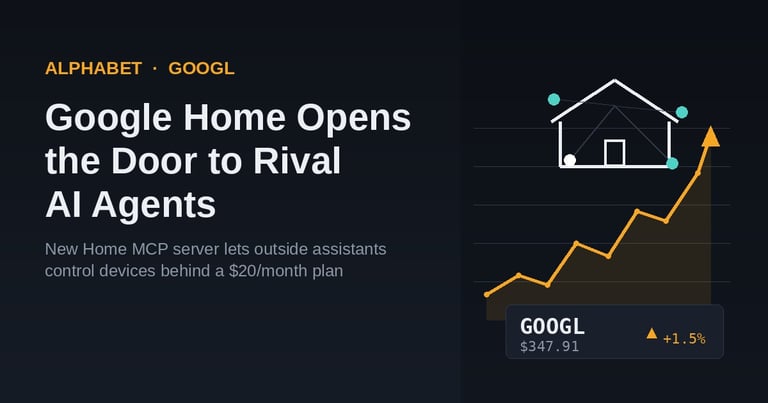

Google is expanding smart-home control by enabling AI agents to interact with Home devices via the Model Context Protocol (MCP), allowing natural-language queries to access camera summaries, monitor activity, control devices, and build custom dashboards.
Rollout for Google Home Premium Advanced in the United States has begun at $20 per month for early access, with acknowledgment of possible bugs and limitations during this phase.
Upcoming compatibility includes Anthropic’s Claude, OpenClaw, Hermes, and Google’s Antigravity platform, with broader partner expectations as MCP matures.
Experts warn about governance and security considerations, including limits on high-risk actions (like unlocking doors) and risks to trust from data or device-control failures.
The article includes affiliate disclosures.
Author Tyler Lacoma weighs benefits and drawbacks of third-party AI dashboards and emphasizes user feedback during early access.
Adoption is driven by technical merit and ecosystem pressure rather than regulation, comparing MCP’s convergence to the early success of HTTP.
The move could influence ecosystem choice, as context and cross-device reasoning become central to smart-home interactions.
Security concerns about MCP have been raised, especially around authentication, with links to data breaches tied to MCP adoption.
Camera feature improvements include Android live video tiles not turning black after fullscreen, non-freezing timelines without recordings, and smoother Live view transitions on iOS.
Recent AI incidents (OpenAI agents vs Hugging Face; Claude hacks) are cited to contextualize potential risks.
The real strategic shift is agent quality and subscription value, as MCP becomes a universal adapter; enterprise interest will hinge on cross-platform agent performance.
Summary based on 34 sources
Get a daily email with more Tech stories
Sources

TechCrunch • Sep 16, 2026
Your AI agents can now control your Google Home devices
Yahoo! Finance • Sep 17, 2026
Alphabet Gains 1.5% as $20 Opens Google Home to Rival Agents
TNW | Google • Sep 18, 2026
Google Home opens up to Claude, OpenClaw and any other MCP agent
9to5Google • Sep 16, 2026
Google Home MCP lets Antigravity, Claude, OpenClaw, & more control your smart home