Quantum Threat Looms Over Bitcoin Security: Shor’s Algorithm Could Crack Public-Key Cryptography
September 17, 2026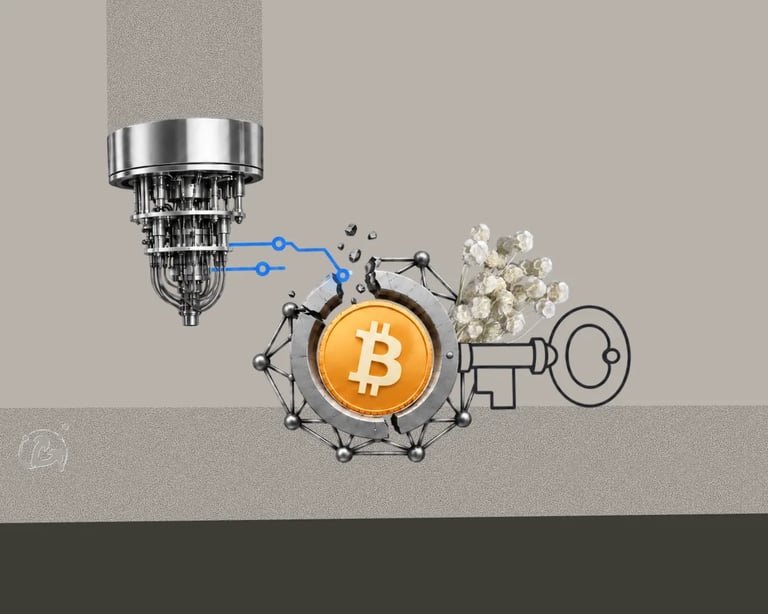

Shor’s algorithm, a quantum method for factoring large integers and solving discrete logarithms, threatens widely used public-key cryptography such as RSA, Diffie-Hellman, ECDSA, and Schnorr signatures.
Bitcoin's security rests largely on secp256k1; once a public key is exposed, a quantum attacker could derive the private key with Shor’s algorithm, compromising signatures.
Timeline for quantum readiness remains uncertain, with some estimates targeting readiness around 2029 and more dangerous quantum machines in the 2030s, while real progress varies and may outpace early forecasts.
Practical guidance for holders includes avoiding address reuse, moving funds from exposed addresses to new ones, monitoring wallet upgrades for post-quantum signatures, demanding open audits for any claimed quantum protection, and pursuing a careful migration rather than rushed changes.
Independent researchers have shown small-scale quantum progress, such as 15-bit elliptic-curve tests, but a true Bitcoin-scale breakthrough is distant due to the need for many error-corrected qubits.
Mining and SHA-256 show more resilience to quantum attacks, because Grover’s algorithm offers only a quadratic speedup; extending hash lengths could mitigate this risk.
Estimates of the quantum resources needed to break keys have fallen, with breaking a 256-bit key potentially requiring hundreds of thousands of physical qubits on superconducting systems or tens of thousands on ion-trap setups, depending on architecture and error correction.
Industry responses include adopting NIST post-quantum standards (ML-KEM, ML-DSA, SLH-DSA, HQC) and planning deprecation of classical RSA and elliptic curves in government use by around 2035, as well as Bitcoin community discussions of BIP-361 and Ethereum’s exploration of post-quantum signatures.
Shor’s algorithm works by turning factoring or discrete-log problems into a hidden-period finding task via quantum superposition and interference, followed by classical post-processing to extract factors or keys.
Vulnerability depends on whether the public key is exposed: P2PK and Taproot-using addresses reveal keys on-chain, increasing risk, while P2PKH/P2WPKH with unspent or hashed keys offers more protection.
Shor’s algorithm was developed by Peter Shor in 1994 at Bell Labs, catalyzing advances in quantum computing and post-quantum cryptography.
Summary based on 1 source
Get a daily email with more Crypto stories
Source

ForkLog • Sep 17, 2026
What Is Shor’s Algorithm and Why Does It Threaten Bitcoin?