NASA Taps Blue Origin for Mars Telecom Network Despite Recent Setbacks; $700M Contract Secured
September 2, 2026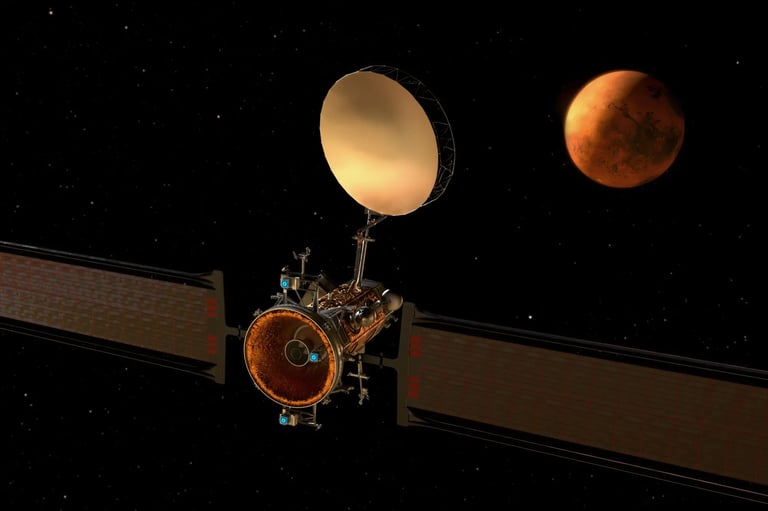


The MTN is part of NASA’s Artemis-era strategy to support sustained lunar activity while building out a broader Mars data and communications network for crewed missions in the future.
The award reflects NASA’s broader push to rely on commercially provided space infrastructure, following programs like Escapade to study Mars and solar wind interactions as part of a larger procurement approach.
Blue Origin has faced recent setbacks, including a hot-fire test explosion of the New Glenn that damaged a launch pad and raised questions about readiness and safety, acknowledged by the company’s leadership.
Public market outlook for AST SpaceMobile shows heavy near-term losses and lower-than-expected revenue, but executives argue that ongoing capital expenditure will unlock long-term value as the infrastructure layer monetizes.
NASA has awarded Blue Origin a contract to develop the Mars Telecommunications Network, a high-bandwidth communications and navigation system for Mars missions, with a potential value up to $700 million and delivery of a telecommunications orbiter by the end of 2028.
SpaceX completed a record-setting Falcon 9 flight, delivering another batch of Starlink satellites with high reuse metrics, while a booster landed on a droneship and launches continue at a rapid cadence.
Analysts and institutional investors are increasingly covering space stocks, with Berenberg initiating coverage and a projection that the global space economy could exceed $500 billion in 2025 and near $1 trillion by 2030 due to cheaper launches and scalable satellite networks.
Planet Labs and other space firms are benefiting from a broad sector-wide re-rating as investors chase opportunities across launch, data, and communications plays.
Astroscale Japan selected Isar Aerospace to launch ADRAS-J2 to perform the first debris capture and deorbit mission using Astroscale’s robotic arm, targeting a 3-ton Japanese upper stage in LEO.
Russia’s Rassvet constellation is failing to reach its intended 800 km orbit due to propulsion reliability concerns and tracking data showing altitude shortfalls.
Toyohiro Akiyama, the first Japanese citizen in space, has died at 84, remembered for his daily broadcasts during the Mir mission in 1990.
Insider buying at AST SpaceMobile, including a sizable purchase by director Adriana Cisneros, along with anchor stakes from institutional investors, signals confidence in regulatory approvals and commercialization timelines.
Summary based on 12 sources
Get a daily email with more Tech stories
Sources

Slashdot • Sep 2, 2026
NASA Selects Blue Origin As Mars Telecommunications Network Provider - Slashdot

Engadget • Sep 1, 2026
Blue Origin Wins NASA Contract For Telecommunications On Mars
Space • Sep 2, 2026
Blue Origin wins $700 million contract to build NASA's next Mars orbiter