UC San Diego Scientists Expand DNA Alphabet with Stable Synthetic Base Pairs in E. coli RNA Polymerase
September 2, 2026

A PNAS study led by Dong Wang shows RNA polymerase can faithfully transcribe DNA containing non-natural base pairs, using the same biochemical and structural cues it uses for natural bases.
The research, published August 12, 2026, demonstrates that synthetic base pairs are recognized in a native-like manner, enabling a robust eight-letter alphabet in transcription.
A related PNAS article titled Hydrophobic Unnatural Base Pair Promotes Trigger Loop Closure and Catalysis in Cellular RNA Polymerase Independent of Hydrogen Bonding further explores how non-natural bases influence transcription dynamics.
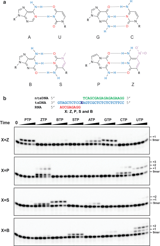
Comparative data indicate that Z-containing systems favor trigger loop closure and faster PTP incorporation, while Z* modifications modulate selectivity and maintain elongation capability.
Cryo-EM structures reveal that P:Z and P:Z* base pairs adopt Watson–Crick geometries in the active site and promote trigger loop folding, with two distinct elongation complex states analyzed.
A water-mediated interaction involving Z influences bridge helix and trigger loop dynamics, suggesting single water molecules can affect transcriptional behavior and guide future alphabet design.
A higher-fidelity Z* analog (2′-F-α-carboxamide-Z) reduces misincorporation, notably of dZ:GTP and dS:ZTP, while preserving productive P:Z pairing and elongation.
Z can mispair with guanine due to deprotonation, but the Z* modification substantially lowers misincorporation while maintaining pairing with P.
A nitro-group–mediated π-hole interaction at the dZ site stabilizes a bend in the bridge helix and shifts TL folding toward the closed state, boosting dZ:PTP reactivity.
Overall results show that P:Z and Z-like analogs are accommodated by E. coli RNAP in a native-like manner, enabling stable transcription of an expanded eight-letter alphabet.
For dP:Z*TP, three TL states are observed with SI3 movements during substrate loading and TL engagement, though catalytic metal coordination differences suggest subtler advancement.
The eight-letter system, using P:Z and B:S, is efficiently processed by polymerase, with P:Z incorporation rates only about twofold slower than natural G:C under tested conditions.
Summary based on 10 sources