Florida Expands Python Removal Efforts as Invasive Snakes Spread Beyond Everglades
September 21, 2026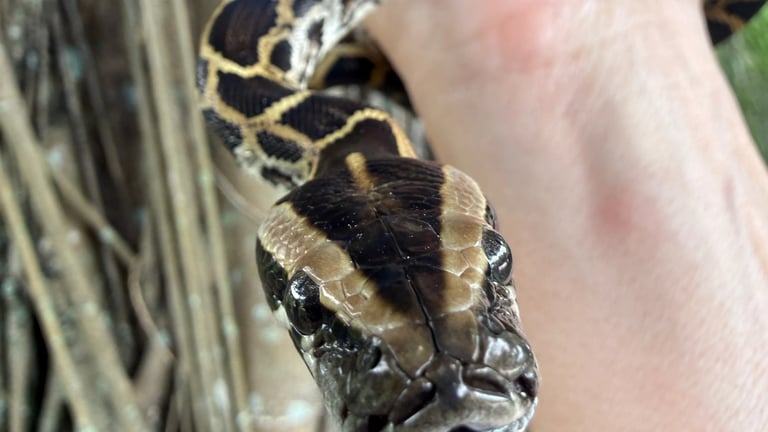

Researchers tracked over 350 Burmese pythons in South Florida from late 2017 through 2024 to study their tree-climbing behavior, using weekly location data and classifying activity into six categories including basking, resting, moving, aggregating, eating, and brooding eggs.
The findings reinforce that Burmese pythons are habitat generalists, capable of thriving in a wide range of environments, which complicates control efforts.
Monitoring relied on VHF radiotelemetry across sites such as Big Cypress National Preserve, including 188 adults and 168 juveniles.
Removing breeding females reduces future predation pressure and egg production, providing benefits beyond the individual captures.
Lead author Alex Romer and co-author Melissa Miller emphasize that targeting key demographic groups yields the most impact at new invasion sites and along the invasion front.
USGS is developing population models using removal data to better estimate abundance and evaluate control programs, rather than relying solely on removal tallies.
Experts say incorporating demographic weighting into management decisions can guide removal strategies and incentives, improving efficiency in controlling the invasive population.
While removing adults and eggs matters, estimating total population remains difficult, with the broader aim of reducing long-term population pressure to protect native species.
Initial model accuracy is around 44%, with better detection of large reproductive females than smaller individuals.
Targeting mature, especially large reproductive females, can reduce population growth more effectively than removing equal numbers of smaller snakes.
Rationale for focusing on reproductive females is that removing them lowers population and leverages mating behavior to locate hidden snakes.
The study analyzes age, size, sex, and reproductive capacity to identify the segments that most efficiently reduce the population, notably large reproductive females.
Summary based on 18 sources
Get a daily email with more Science stories
Sources
USA TODAY • Sep 21, 2026
Burmese pythons have established a foothold outside Florida Everglades