Study Reveals Weakening of Key Atlantic Ocean Current, Signaling Climate Change Risks
September 23, 2026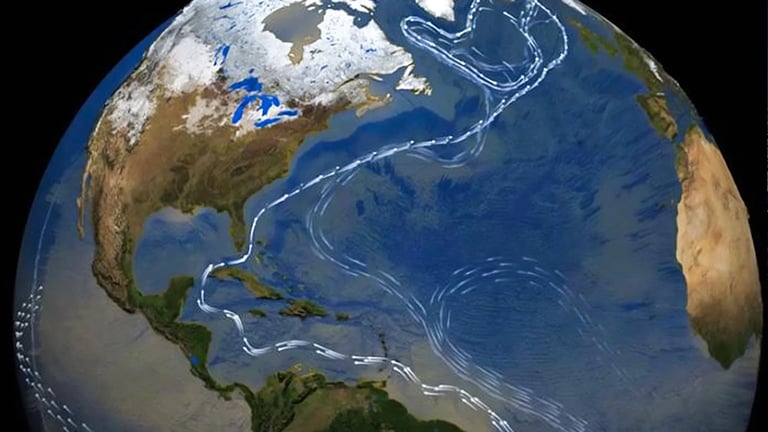

A new study indicates this weakening spans a broad region of the western North Atlantic, suggesting potential global climate implications.
Experts advocate strengthening deep-sea marine observations to better understand global circulation changes and their regional impacts, including near Indonesia.
The findings were published in Science Advances on April 8, with support from the U.S. National Science Foundation and UK Natural Environment Research Council.
Modeling links Atlantic circulation changes to Arlindo via Kelvin waves, though observational proof is not yet conclusive and factors like ENSO and monsoons also influence Indonesia’s waters.
Researchers used seabed-mounted instruments at four Atlantic sites to monitor deep-water pressure, temperature, density, and movement, focusing on deep (>1,000 meters) circulation components unseen from the surface.
Bottom-pressure records from four western Atlantic arrays were analyzed with a consistent method to assess deep-water overturning strength.
The study underscores the value of long-term ocean observations to distinguish enduring change from natural decadal variability in AMOC.
AMOC transports heat northward and drives a global pattern of temperatures, rainfall, sea levels, and storm activity, so its weakening could affect European winters, rainfall regimes, and coastal seas.
A slower AMOC alters weather and could intensify extremes, shifting precipitation and potentially raising sea levels along Atlantic coastlines.
AMOC may serve as an early warning signal for broader climate shifts, with western Atlantic measurements acting as a canary in the coal mine for long-term changes.
Science Advances researchers report a meridionally consistent decline in the western Atlantic’s boundary contribution to AMOC, indicating a widespread pattern from about 16.5°N to 42.5°N.
The Atlantic Meridional Overturning Circulation (AMOC) is weakening, with long-term signals appearing over roughly the past two decades from four western North Atlantic monitoring sites.
Summary based on 2 sources
Get a daily email with more Science stories
Sources
ScienceDaily • Sep 23, 2026
Scientists say a critical Atlantic Ocean current is weakening and the effects could be global